
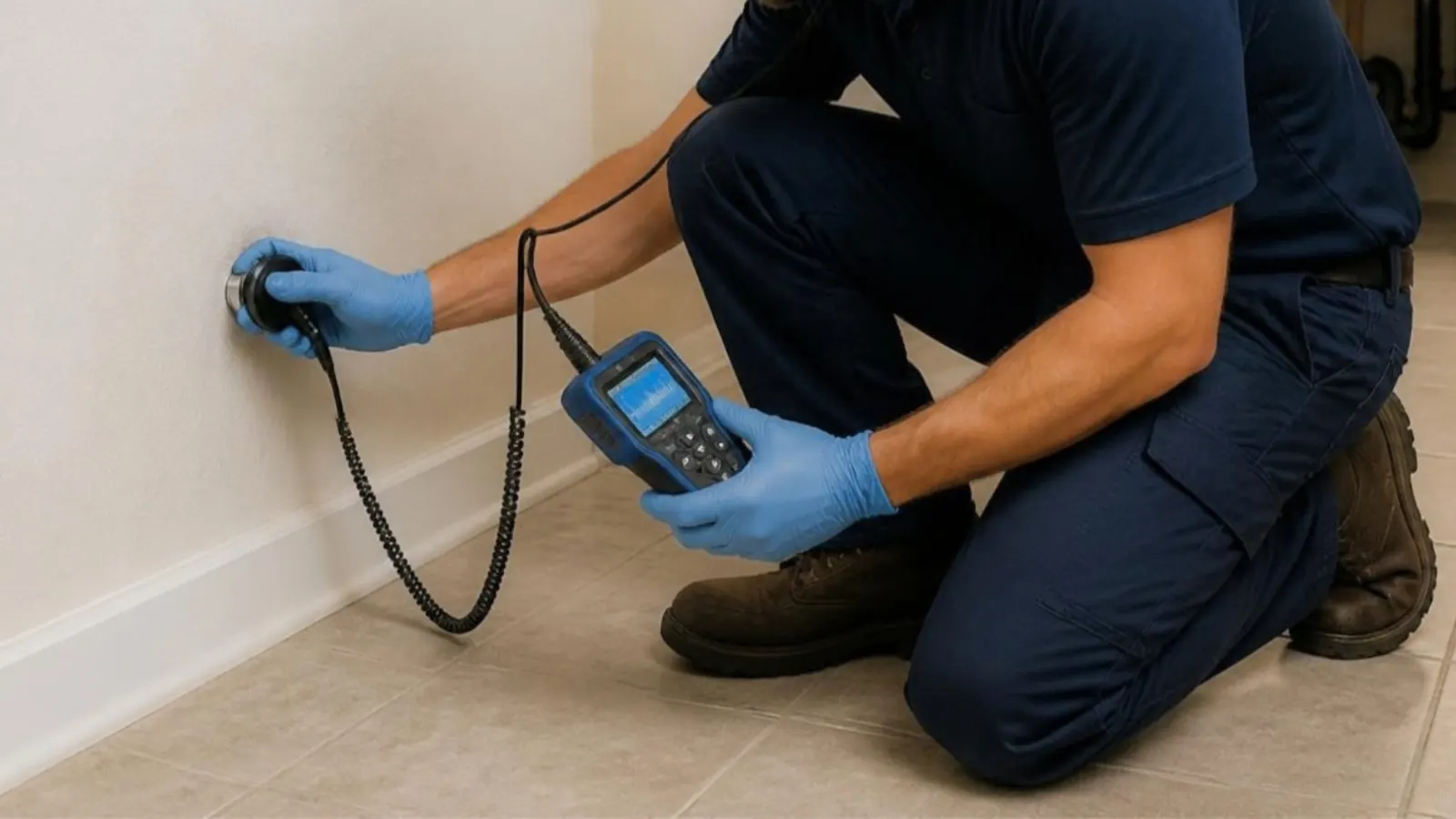
People search water leak detection camera and expect one device. In practice there are two. A pipe inspection camera is a lens on a flexible cable that goes inside a drain or sewer line. A thermal camera, also called an infrared camera, is a handheld device that reads surface temperature on walls, floors and ceilings.
Each answers a different question for a Dolton, IL homeowner. One tells you what the inside of a drain looks like. The other hints at where a wet area is hiding behind drywall.
Inspection camera versus thermal camera
Use this table to match the tool to your problem.
| Question | Inspection camera | Thermal camera |
|---|---|---|
| What it sees | Inside of drain and sewer pipe | Surface temperature differences |
| Typical use | Roots, cracks, offsets, bellies, blockages | Cold or warm patches from hidden water |
| Finds supply line leaks | No, it only goes in drains | Sometimes, if the pipe is warm and close to the surface |
| Finds drain line leaks | Can see cracks and joints, not always the leak | Sometimes, if the wet area cools the wall |
| Main limit | Needs a path in through a cleanout | Shows temperature, not water, so it needs a second check |
What an inspection camera shows you
A sewer camera head is about the size of a golf ball, with lights and a lens, pushed on a cable through a cleanout. It shows the pipe wall, any roots entering at a joint, a crack, a sag that holds water, a joint pulled apart and grease or scale on the wall.
It does not show a leak in a pressurized supply pipe. If water is leaking from a copper or PEX line, the camera has nothing to look at. Where it helps is a drain line that is failing, which can make a wet spot in a crawlspace, slab or yard.
Most useful is the recording. Ask for the video so you can show the footage to a second contractor. Our sewer camera inspection comes with that option.
Suspect a hidden leak?
Call the 24/7 line. We will ask what you see and decide whether a camera, a meter test or a pressure test comes first.
What a thermal camera can and cannot do
Thermal cameras get a lot of marketing credit. They are useful with a little skepticism.
It can help with
- Finding a cold patch where a wall is wet
- Tracing a hot supply pipe under a floor
- Checking a ceiling stain for ongoing moisture
- Showing where to open a wall as little as possible
It cannot do
- See through a wall, it reads only the surface
- Confirm water, since it only shows temperature
- Find a small leak in a cold pipe near a cold wall
- Replace a pressure test or a meter check
A good thermal reading becomes a clue. The confirmation comes from a moisture meter, a pressure test or opening the wall.
How we actually find a hidden leak
Cameras are one step. The order of steps usually looks like this.
Check the meter
With every fixture off, a moving meter dial or a spinning low-flow indicator means water is going somewhere.
Isolate the system
Closing valves in stages shows which section is losing water, such as the heater, the supply lines or an outside spigot.
Use the right sensor
Acoustic listening, thermal imaging, a moisture meter or a drain camera, depending on the symptom.
Confirm before opening
We confirm the spot before cutting a wall and explain the repair, so a small opening is the goal.
Water in a Dolton basement is not always a pipe leak
The Cook County hazard mitigation plan for Dolton describes repeated basement flooding across entire neighborhoods, and it says some of it comes from the sewer backing up during severe rain. A wet basement floor after a storm is therefore a drain and groundwater question first.
A camera run through your line helps sort whether the water came from a failed drain, a crack or the street side. For a supply leak, watch the meter. If it moves after a dry week with nothing running, the leak is inside your plumbing. Dolton Water Department at 708-201-3293 can answer billing and meter questions.
Source: Cook County hazard mitigation plan annex for Dolton, 2024, and Village of Dolton Water Department page.
Signs it is time to call for leak detection
Hidden leaks leave clues long before a wall fails.
- A water bill that climbs while habits stay the same
- The meter keeps moving with everything off
- A musty smell, bubbling paint or warped baseboard
- A warm spot on a floor where no heating line should run
- A sound of running water behind a wall at night
- A damp patch in the yard between the house and the street
Reading the picture honestly
Footage can mislead if nobody explains it. A dark ring in a sewer pipe may be a joint, a stain or a crack, and a fuzzy grey patch may be roots or scale. A technician should call out the distance on the cable counter so you know where to dig if it comes to that.
Thermal images have the same problem. A blue patch could be a wet wall, a cold window draft or a missing patch of insulation. Ask for a visible light photo beside each thermal image and for a second method to confirm.
Buying a camera yourself
Handheld thermal cameras that plug into a phone are affordable and fun to use. They work best as a screening tool. A cheap drain camera can look into a trap or a short line, but cables are short and it may jam on a bend.
For a main drain or a long run, a professional machine with a self-leveling head and a locator is worth it. Our leak detection service combines meter tests, listening gear and cameras so you are not paying for guesses.
Nearby towns we visit
We work from Sibley Boulevard in Dolton and also visit Riverdale and South Holland homes. The tools are the same wherever the leak is.
What to do before you buy or book a camera inspection
A camera shows what a pipe looks like inside, but it does not replace first steps. According to the Illinois Department of Insurance, photographing and inventorying belongings early protects an insurance claim, so start there.
- Close the main valve if water is actively running, then note what the meter does with everything off
- Photograph wet areas and damaged belongings before moving or drying anything
- Write down when the symptom started and which fixtures are involved
- Call JULIE at 811 at least 48 hours before any digging so utility lines are marked
- Ask whether the inspection includes a recording you can keep for your agent or a buyer
Questions readers ask
Not by looking inside it, since supply pipes are small and pressurized. Finding that leak takes meter tests, listening gear or pressure tests. A camera is for drains and sewer lines.
It is a screening tool. It shows a temperature pattern, and a moisture meter or an opened section confirms it.
Ask when you book. A recording is useful to show an insurer or a second contractor, and we are happy to explain what each frame shows.
A camera head moving through a sound pipe is gentle. In a badly broken line, pushing a cable can snag, which is why the first pass is slow.
Turn off every fixture and appliance, then watch the low-flow dial on the meter. If it moves, water is leaving the house somewhere. Call us and we will narrow it down.
Often yes. Acoustic listening and pressure tests narrow the spot before any concrete is cut.