
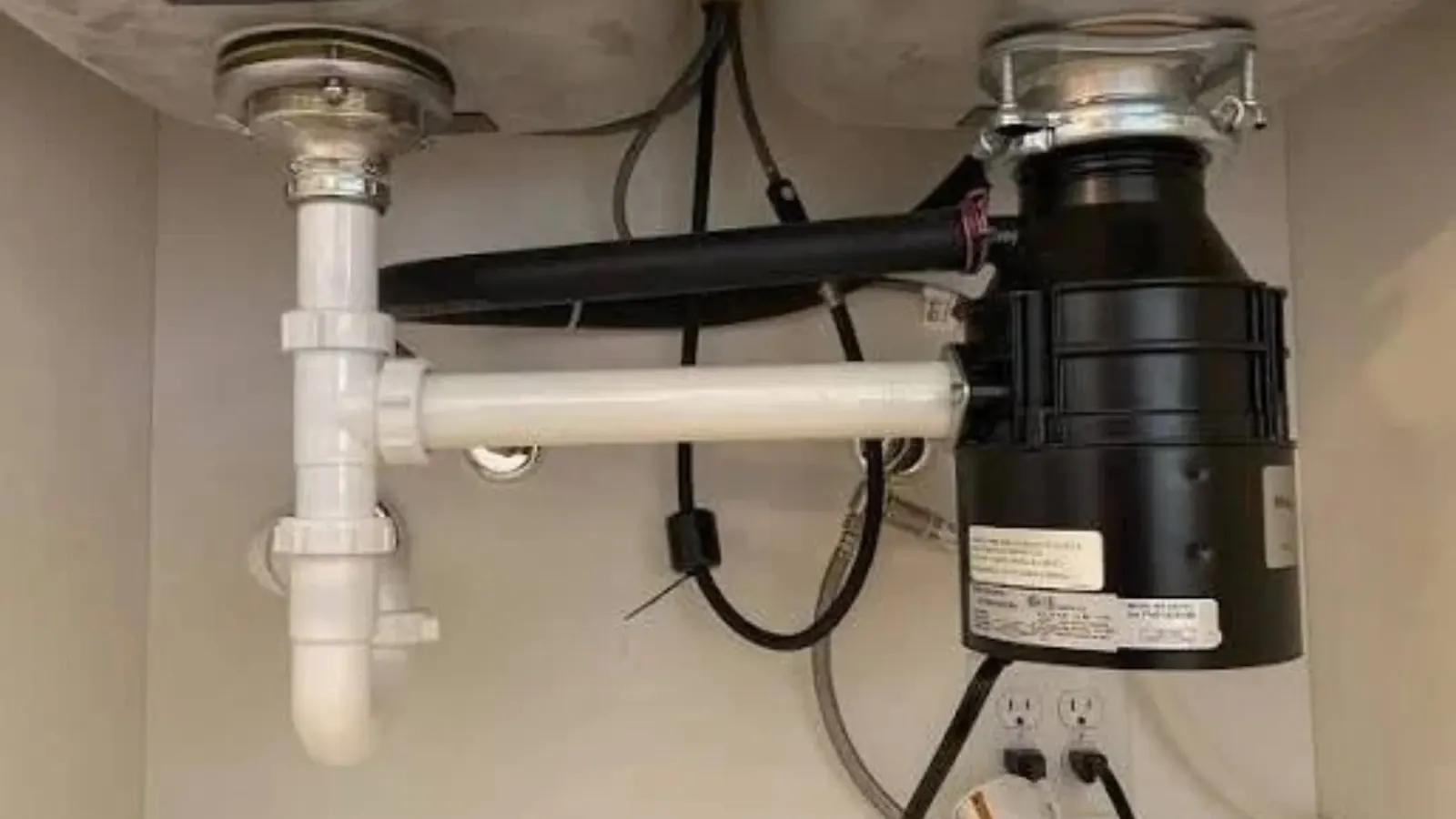
Emergency garbage disposal repair in Dolton, IL covers a unit that is jammed, humming without turning, leaking under the sink, or backing water into the second basin. Our 24/7 line is answered nights and weekends. Turn the wall switch off, and unplug the unit or flip its breaker. Do that before anything else, and never put a hand into the opening, even when it is off.
A disposal is a small motor driving a spinning plate inside a grinding chamber. It does not have blades like a blender, and it cannot handle everything. Most calls come down to a jam, a worn seal, or a drain that is blocked beyond the unit.
Disposal jammed or leaking: what to do first
Safety comes before the fix. A disposal that looks dead can start spinning the moment power returns.
Cut the power
Switch it off at the wall, then unplug it under the sink or turn off its breaker. A plain switch is not enough if a hand might go near the opening.
Look, do not reach
Shine a flashlight into the opening. If you see a spoon, bottle cap or bone, lift it out with long tongs or needle-nose pliers.
Free the plate from below
Many units have a 1/4 inch hex socket on the bottom center. Turn a hex wrench back and forth until the plate moves freely, then press the red reset button.
Stop using the sink if it leaks
Put a bucket under the unit and close both stops under the sink. Do not run the dishwasher until we check the drain hose.
Do not use chemical cleaner
Caustic liquid in a stalled unit splashes back and attacks seals. It does nothing for a mechanical jam.
Read the symptom before you call
Where the unit leaks or how it sounds tells us most of what we need to know.
| What you notice | Likely cause | What happens next |
|---|---|---|
| Hums but the plate will not turn | Jammed grinding plate | Hex wrench reset, then a test run |
| No sound, no hum | Tripped reset button, switch or outlet | Check the power path, then the motor |
| Drips at the top, around the sink flange | Failed mounting seal | Reseat the flange with new putty or gasket |
| Drips at the side where a hose attaches | Loose or cracked dishwasher drain hose | Reclamp or replace the hose |
| Water seeps from the bottom of the housing | Internal shaft seal failed | Replace the unit, repair is not practical |
What must never go down a disposal
Most jams and clogs are the result of a short list of foods. The list is the same for every brand.
- Grease, oil and fat, which cool and coat the drain pipe after the unit
- Stringy vegetables such as celery stalks, corn husks and onion skins
- Rice, pasta and oatmeal, which swell into paste
- Large bones, fruit pits and nut shells
- Coffee grounds in volume, since they pack into a dense layer
- Glass, metal, plastic and bottle caps
Disposal jammed or leaking?
Switch it off at the wall and call the 24/7 line. We will tell you what to check first.
Your dishwasher drain runs through the disposal
The dishwasher drain hose connects to a small spout on the side of the disposal. If dishwasher water backs up into the sink, or the dishwasher stops draining, the problem may be at that spout rather than in the machine.
A new disposal ships with a plastic knockout plug blocking that spout. If it is not removed during installation, the dishwasher cannot drain at all. We check this on every install, and we confirm the hose forms a high loop so sink water cannot siphon backward.
When water backs up in the sink and the unit is clear, the blockage sits further down the line. That is a job for our drain cleaning crew, and we can do it in the same visit.
Repair it or buy a new one?
A jam caught early often clears with one hand tool. Other failures decide the question for you.
Repair is reasonable
- The plate turns after a hex wrench reset and the unit runs cleanly
- The leak is at the top seal or the dishwasher hose
- The motor is quiet and the housing is dry
- A reset button trips only once in a while
Replace is the better bet
- Water seeps through the bottom or the side of the housing
- It jams again within days of a reset
- The housing is rusted or the motor is loud and weak
- The unit is undersized for the household
If the sink itself is also being replaced, our plumbing installation work lets us set both in one visit.
How a replacement unit is installed
A swap takes planning around power, space and the drain connection.
Power off and disconnect
We cut power, disconnect the drain trap and the dishwasher hose, and loosen the mounting ring.
Lift the old unit and clean the flange
Old putty is scraped away so the new mount seats flat and tight.
Mount and align
The new unit hangs from the sink flange, the trap is reconnected, and the dishwasher hose goes on after the knockout is cleared.
Power up and test
We run water, test the dishwasher drain, check every joint for drips, and show you the reset button and the hex socket.
Coverage, access and honest limits
We work out of 1205 E Sibley Blvd and cover ZIP 60419 in Dolton, plus Harvey and other nearby towns. Landlords can give us a unit number and an on-site contact.
We will not recommend a repair that will not hold. If the housing is leaking at the bottom, a new unit is cheaper than the labor to reseal a dead one. If the disposal is fine and the kitchen line is the real problem, we say so before we start.
Electrical and manufacturer guidelines for disposals
A disposal is a wired appliance, so electrical rules apply alongside plumbing ones. Electrical work follows the National Electrical Code (NFPA 70) as adopted locally, and a brand-new circuit is electrician work. Swapping a unit onto an existing plug or hardwire connection is routine.
The most useful guideline on any disposal is the manufacturer's own sheet, which names the reset button, the hex socket size and the fastening style for that model. Keep it, or look the model up before you start.
Sources: National Electrical Code (NFPA 70), manufacturer instructions.
Garbage Disposal Repair questions in Dolton, IL
Yes. The 24/7 line is answered nights, weekends and holidays. Tell us whether the unit is jammed, humming or leaking, and we book the first appointment available for your address.
Something is wedged between the plate and the chamber wall, or the motor has stalled. Switch the power off, free the plate with the hex wrench on the underside, then press the reset button.
No. Remove objects with tongs. A switch can be flipped by mistake, and a unit that is wired or plugged in can restart. Cut power at the plug or breaker as well.
The drain hose is connected to the disposal, so a clog or a missing high loop can send water into the basin. We check the hose, the knockout plug and the line past the unit.
It varies with use and with what goes in. A leak at the bottom of the housing or a motor that keeps tripping is a sign the unit has reached the end of its life.
Yes. Check that it fits under your sink and matches your power setup. Tell us whether the old one was hardwired or plugged in so we plan the electrical connection.