
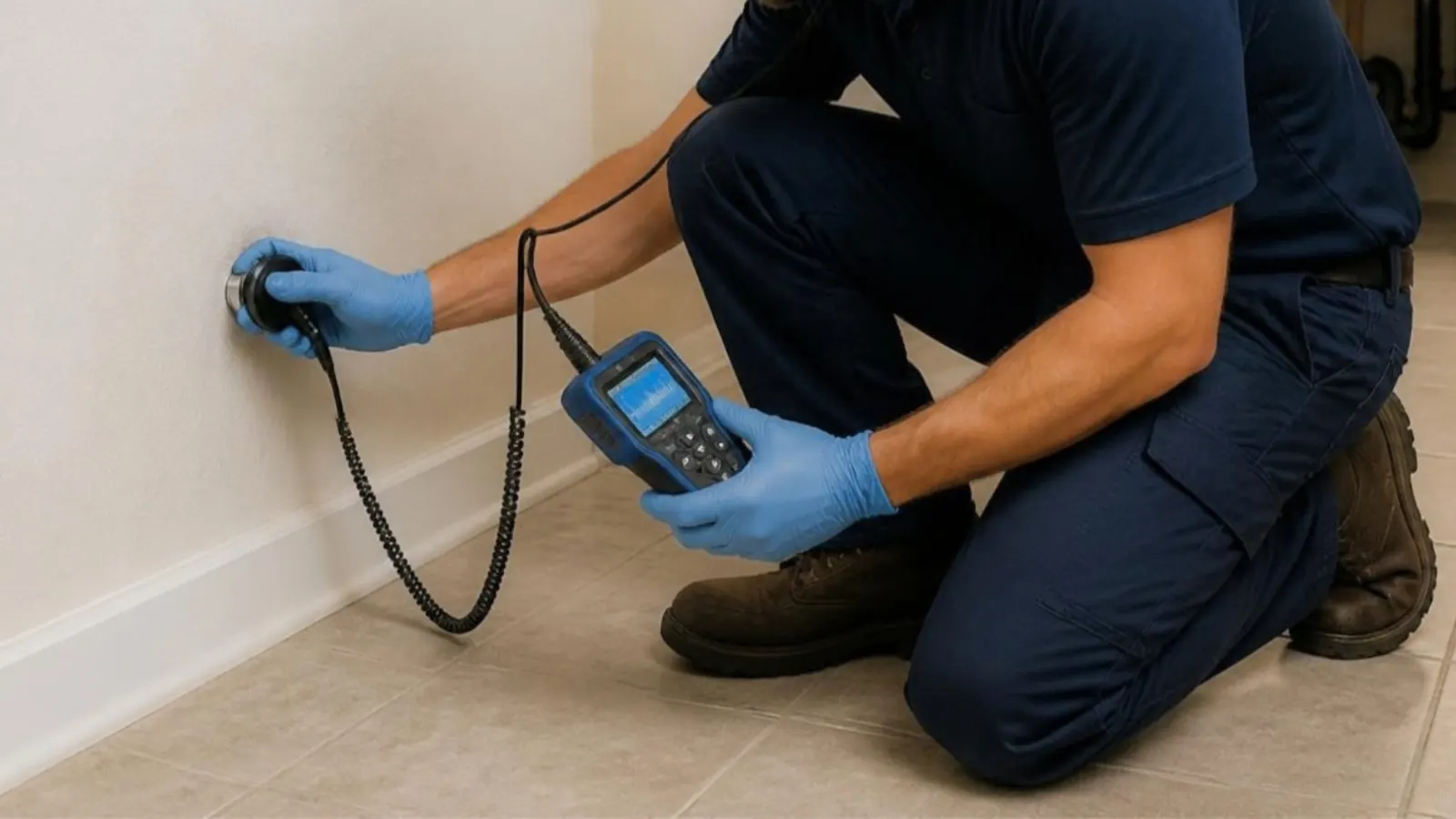
Leak detection in Dolton, IL is the job of finding exactly where water is escaping from a pipe you cannot see, so the repair can be small instead of a demolition. Our 24/7 emergency line is answered at night, on weekends and on holidays, and if water is actively pouring, shut off the main first and then call.
Most leaks announce themselves through a symptom, not a puddle. A stain, a hot patch of floor, a weak shower or a bill that jumped can each point to a different part of the system, so this page is organized by what you notice. Start with the one that sounds like your house.
Water leaking somewhere you cannot reach: do this first
A hidden leak can wait a few minutes while you limit the damage. These steps cost nothing and make the search faster.
Find and close the main
The main shutoff is usually where the water line enters the house, often in the basement near the meter. Turn the handle until it stops. A round wheel turns clockwise, a lever goes a quarter turn across the pipe.
Open one faucet low in the house
With the main closed, a tap on the lowest level drains the pipes and lowers pressure on the leak. Close it again once the flow stops.
Cut power near anything wet
Water dripping through a ceiling can reach light fixtures and outlets. If the area is wet, switch off that circuit at the panel only if the panel is dry and you can reach it safely.
Catch and photograph
Put a bucket under drips, move belongings, and take photos of every stain and wet surface with the date visible. Your insurer will ask for them.
Note what the meter does
If you can reach the water meter, write down the dial reading, wait twenty minutes with everything off, and look again. Tell the dispatcher what you saw.
The meter keeps running or the water bill jumped
A spinning meter with every fixture off is the clearest sign that water is leaving your pipes somewhere. Most meters have a small triangle or dial that turns when even a trickle passes through. If it moves with nothing running, the leak is real, and the question becomes whether it sits inside the house or on the buried line outside.
Here is a simple split. Close the main shutoff inside the house and watch the meter again. If the dial stops, the leak is on the house side of the valve. If it keeps turning, water is escaping between the meter and the valve, which usually means the buried service pipe. That test alone saves an hour of searching.
A higher bill with a quiet meter is different. Toilet flappers that leak silently into the bowl are the most common cause, and a few drops of food coloring in the tank will show it. Before assuming a pipe leak, rule out the toilet. Our toilet repair crew handles that fix.
For questions about the meter itself, billing, or a reading you do not trust, call the Dolton Water Department at 708-201-3293. We can find leaks on your side of the meter, but the meter and the bill belong to the village.
Wet ceiling, stained wall or a warm floor
These three symptoms look different but they all say the water is traveling. The wet spot is rarely the leak.
Wet ceiling below a bathroom
Water follows joists and pipes before it drips, so the source is often several feet from the stain. Supply lines, a tub drain or a shower valve are common culprits.
Bubbling paint or soft drywall
Water inside a wall wicks upward and sideways. A moisture meter reads the wall and tells us how far the dampness has traveled.
Warm spot on the floor
A hot water line leaking under a floor warms the surface above it. It can also mean a heating line, so we confirm which system it is.
Musty smell with no visible water
Damp insulation or a wet cabinet base can smell for weeks before any stain appears. Thermal imaging often shows the cold, wet patch.
Sound of running water
A faint hiss inside a wall at night, when the house is quiet, is the sound acoustic gear is built to chase.
Low pressure that has no other explanation
If the shower went weak and the aerator is clean, a leak can be stealing pressure before the water reaches the fixtures. The clue is that the weakness shows up on several taps, not one. Compare hot and cold. A drop on hot only points toward the water heater side. A drop everywhere, especially with a meter that turns, points toward the service line.
Low pressure also comes from a partly closed valve, a failing pressure reducing valve or old galvanized pipe that has narrowed inside. Detection tells us whether water is escaping. If it is not, the answer may be our repiping work instead, and we will say so.
Symptom to likely location to first method
This is how we usually decide where to start. A technician confirms it with the right tool on site.
| What you notice | Likely place | First method |
|---|---|---|
| Meter turns with everything off | Service line or house piping | Main shutoff test, then acoustic listening |
| Ceiling stain under a bathroom | Supply line or drain above | Moisture meter, thermal imaging |
| Warm floor patch | Hot line in or under the floor | Thermal imaging, pressure test |
| Soggy spot in the yard | Buried water line | Ground microphone, tracer gas |
| Pressure low on every tap | Line leak or narrowed pipe | Pressure test, then camera if needed |
| Wet crawlspace or damp basement wall | Overhead supply or drain, or groundwater | Visual check, moisture meter |
Not sure where the water is going?
Call the 24/7 line, describe the stain or the meter, and we will plan the right gear.
Under the house, in a crawlspace or behind a basement wall
Homes with a crawlspace let a technician see and hear pipes directly, which makes detection faster. We look for wet insulation, rust streaks, mineral stains on joists and drips that follow a pipe to its lowest point. A flashlight and a moisture meter do most of the work.
Basements work the same way, with one extra step. Dampness on a basement wall can be a pipe leak or groundwater coming through the foundation. We shut the main, watch the meter, and look at whether the damp spot dries. If it keeps weeping with the water off, the source is outside the plumbing and our basement waterproofing page is the better starting place.
A buried line, a soggy yard and the meter box
A water line runs underground from the meter to the house, and when it leaks the signs show on the surface. Look for a patch of grass that stays green or soft in dry weather, a sunken spot, or a wet meter box. Wet soil is not proof, because rain and a broken downspout look the same, so we confirm before anyone digs.
We listen along the line with a ground microphone, which picks up the hiss of pressurized water leaking into soil. When the sound is faint, we fill the line with a safe tracer gas that rises through the soil above the break. Once we know the spot, the repair conversation moves to our water line repair page. Before any digging, Illinois law requires a call to JULIE at 811, at least 48 hours ahead, so buried utilities get marked.
Slab leaks: a question that depends on how your home was built
A slab leak is a leak in a pipe that runs in or under a concrete floor. We cannot say how many Dolton homes are built that way, and from what we can tell much of the area has basements, which put pipes in open joists where leaks are easier to reach. Slab leaks are mostly a question for homes built on a slab, such as an addition, a garage conversion or a ground-level unit.
If your home does sit on a slab, the signs are a warm floor, the sound of running water under it, a meter that turns with everything off and damp carpet or flooring with no source above. Acoustic gear and thermal imaging locate the line, and then the options are a repair at that spot, a reroute through the walls or ceiling, or a repipe. We explain each before any floor is cut.
Irrigation, pools and commercial buildings
Lawn sprinklers and pool plumbing leak in ways house pipes do not. An irrigation zone that never drains, a valve box full of water or a soft strip of lawn near a head are the usual clues, and we can check pressure on the supply side. Pool leaks are harder, since evaporation looks like loss, so we test the plumbing lines separately from the shell.
For a store, office or multi-unit building, the process is the same but the paperwork is bigger. We isolate sections of the building, test each, and give the property manager a written location so a repair or an insurance claim has a record. Our commercial plumbing page covers what else we do for businesses. We also take leak calls in nearby Riverdale.
The methods we use, by name
No single tool finds every leak. The right one depends on what the pipe is made of, where it runs and what you can hear.
Acoustic listening
Sensitive microphones on pipes, walls and soil pick up the sound of water escaping under pressure. Works best in a quiet house.
Thermal imaging
An infrared camera shows temperature differences. A hot line leaking into a wall or floor appears as a warm patch.
Tracer gas
A safe mix of hydrogen and nitrogen is pushed into the pipe and escapes at the leak, where a sensor finds it. Useful for slow leaks and buried lines.
Pressure testing
We isolate a section, pressurize it and watch the gauge. A drop tells us a leak exists on that section.
Moisture meters
Probes and pins measure dampness in drywall, wood and subfloor, so we map how far water has spread.
Pipe camera
A small camera on a flexible cable looks inside drains and larger lines for cracks, breaks and offset joints.
What leak detection does not do
Detection finds the leak. It does not fix it, and it does not dry out your house. Once we locate the break, the repair is a separate job with its own price. We repair pipes, and we do not do water damage restoration, mold remediation or drywall finishing, so tell your insurer and a restoration company if walls are soaked.
It also cannot promise a perfect hit every time. Plastic pipe is quiet, a very slow drip gives off little sound and noisy plumbing can mask the hiss. When one method fails we move to the next, and when no leak exists, we tell you that too. A pipe test that holds pressure is a good result, even if it is not the one you hoped for.
What decides the cost of finding a leak
You get a clear price before work starts. These are the factors that move it.
Illinois Department of Insurance guidance is to photograph damage and inventory belongings, and to ask your agent what your homeowners policy covers. Want your real number? Call (773) 207-0518.
What official guidance says to do about a hidden leak
According to the Illinois Department of Insurance, you should photograph and inventory damaged belongings and ask your agent what your policy covers. Do that before cleanup starts, because the photographs are your record of the loss.
For a running meter or a high bill, the Dolton Water Department at 708-201-3293 and Public Works at 708-201-3280 are the offices that handle meters and water mains. Ask them what the meter shows, then call us if the numbers point to your side of the line.
Sources: Illinois Department of Insurance consumer guidance, Village of Dolton Public Works and Water Department.
Leak Detection questions in Dolton, IL
Yes. The 24/7 line is staffed through the night, on weekends and on holidays. If water is flowing now, close the main valve first, then call and we will book the first available appointment for your address.
Turn everything off, read the meter, wait twenty minutes and read it again. Any movement means water is leaving the pipes. Then close the main and test again to see whether the leak is inside or outside the house.
The Dolton Water Department at 708-201-3293 handles meters and billing. If your own piping is leaking past the meter, that is where we come in.
Not to find the leak. Listening gear, thermal cameras and moisture meters work from the surface. We only open a small access hole once the spot is known, and we tell you before we do.
No. Detection locates it. The repair is quoted separately once you see where it is and what the options are.
Yes, if your home has one. We use acoustic listening and thermal imaging to trace the line without breaking concrete, then explain whether a spot repair, a reroute or a repipe makes sense.
No. Rain, a clogged gutter, a broken sprinkler head or a leaking sewer line can all soak soil. We test the water line and, if needed, camera the drain before recommending digging.