
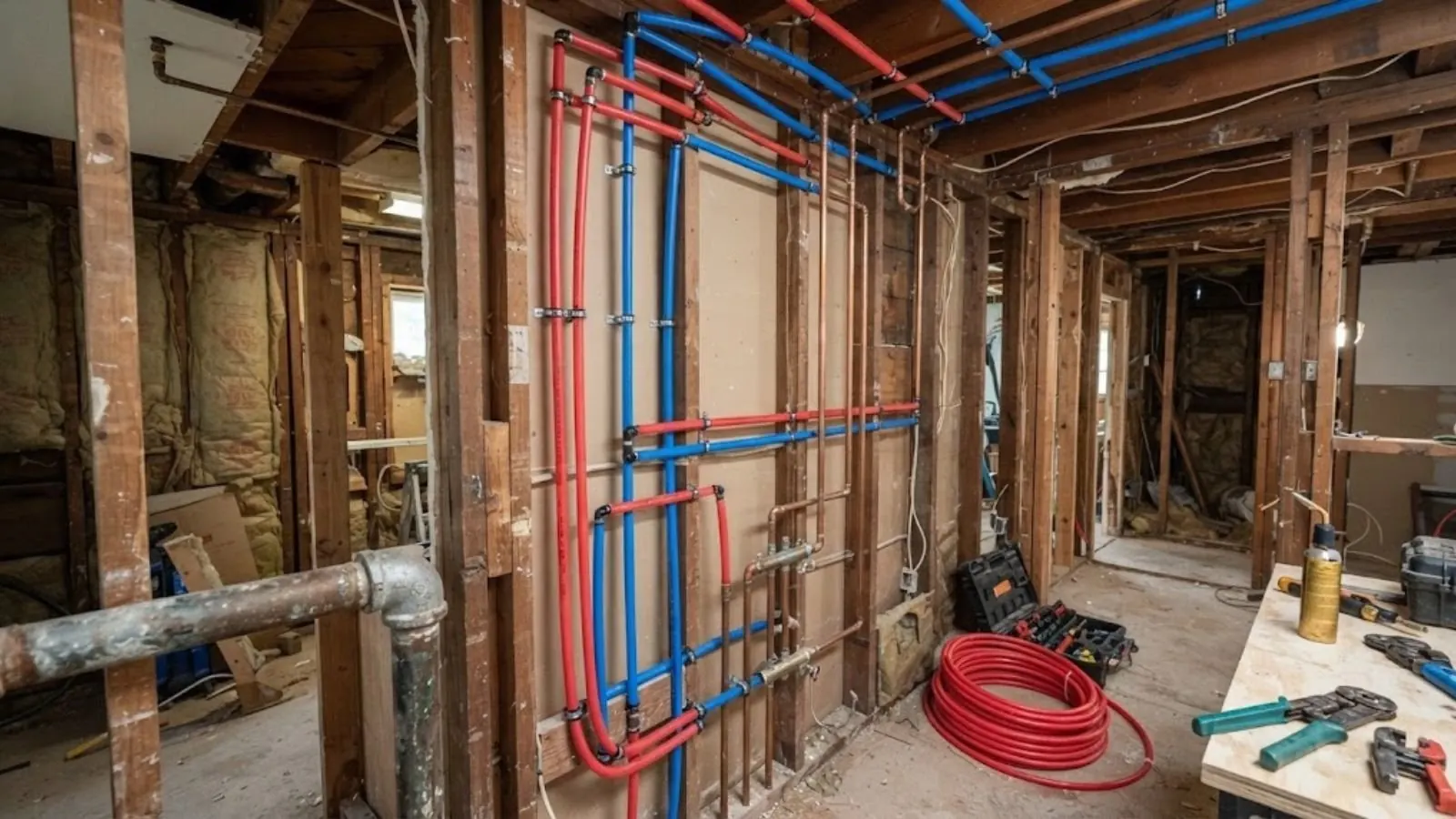
Repiping in Dolton, IL means replacing the water supply pipes inside a house, in part or in full, because the old ones are leaking, corroded or no longer delivering enough water. The 24/7 line is answered if you have questions, and same-day appointments are offered when available, but most repipes are planned rather than rushed.
We cannot say what pipe your house has. Pipe materials vary by the year of the house and the work done since, so the first step is a look, not an assumption. Neighbors in Calumet City call us for the same reason. The sections below cover how to tell if it is time, the materials we compare and what living through the job is like.
Signs your pipes may be near the end
One sign alone is not enough. Several together are a reason to get an assessment.
- Rust-colored or brown water when a tap has sat unused
- Low pressure on several fixtures, with clean aerators
- Repeated leaks in different spots, not the same one
- Green or white crust on copper, or flaking on galvanized steel
- Pinhole drips that appear at a joint or along a run
- Pipe visible in a basement that looks pitted or swollen
Pipe materials compared
Each material suits a different house and budget. Your plumber should say why, not just push one.
| Material | Good at | Watch for | Typical use |
|---|---|---|---|
| PEX | Flexible, fewer fittings, tolerates cold better | Sunlight and some chemicals damage it | Whole-house replacement through walls |
| Copper | Long record, handles heat, repairs well | More labor, pinholing in some water conditions | Exposed runs, upgrades, visible basement lines |
| Galvanized steel | Old standard in older homes | Corrodes inside, narrows, low pressure | Usually the pipe we replace |
| CPVC | Lower cost, easy to join | Brittle with age or in cold | Some cold and hot lines |
Full repipe or fix as it fails
Neither is wrong for everyone. It depends on how much pipe is failing.
Repipe the house
- Ends repeat leaks in aging pipe
- Can raise pressure and flow
- One project, one set of wall openings
- Larger up-front cost
Repair as needed
- Lower cost today when only one section is bad
- Fine for a single isolated leak
- Each break opens a wall again
- Does not fix pipes that are all aging
A burst or a pinhole in a single run belongs with our burst pipe repair work first, and a repipe is the follow-up if that single break exposed wider corrosion.
How a repipe works
A typical job follows this order.
Walkthrough and plan
We trace the existing lines, note every fixture, and choose a route that disturbs the least wall.
Shutoff and access
Water is turned off, and small openings are cut where new pipe must pass. Basements and crawlspaces keep openings to a minimum.
New pipe and fittings
New supply lines connect the main, the water heater and each fixture. Old lines are cut out or abandoned in the wall, whichever is safer.
Pressure test and restore water
We test before anything is closed up, then turn the water back on and check each fixture.
Thinking about repiping?
Call and describe the pipe, the symptoms and the age of the house. We will explain what a look would involve.
What the work disturbs
Expect the water off for part of a day or more, depending on the house. Drywall openings are patched at a basic level, but painting and finish carpentry are separate trades. Homes with open basement joists are faster, while homes with finished ceilings take longer.
We cover floors, keep a path clear and tell you when each fixture is back in use. If a leak has already wet a wall, the repair of that damage belongs with a restoration company, since we repair pipes and do not do water damage restoration.
When a repipe is not the right answer
Low pressure does not always mean bad pipes. A partly closed valve, a failing pressure reducing valve or a leak in the buried service line can all produce the same symptom, and our leak detection work rules those out first. If the service line is the problem, the relevant page is water line repair.
Discolored water is another trap. It can come from pipes inside the house or from the water main, so ask the Dolton Water Department at 708-201-3293 whether work on the main has stirred sediment. If it clears after a few minutes, a repipe may not be needed.
What Dolton's water report says about pipes
The Village of Dolton's 2025 water quality report says lead in drinking water comes mainly from service lines and home plumbing. Its sampling showed a lead 90th percentile of 10.7 ppb against an action level of 15 ppb, and a copper 90th percentile of 0.0335 ppm against an action level of 1.3 ppm. The village says it has developed a service line material inventory.
That is not a diagnosis of your house. If you are worried about lead in your own plumbing, test your tap through an accredited laboratory, ask the Water Department at 708-201-3293 what your service line is made of, and tell us before a repipe so the material choice reflects it.
Source: Village of Dolton Consumer Confidence Report, 2025.
What drives the cost of a repipe
You get a clear price before work starts. These are the real factors.
Insurance rarely pays for pipe replacement caused by age, but ask your agent about a sudden leak. Want your real number? Call (773) 207-0518.
What to do before a repipe starts
A repipe opens walls and shuts water off for part of a day. Doing these things first keeps the visit smooth and the house livable.
- Move furniture, art and fragile items away from walls and ceilings where pipes run
- Plan where the household will wash, drink and cook while the water is off
- Locate the main shutoff and meter so the plumber can confirm the plan
- Ask the Dolton Housing and Permits office whether a permit applies, because rules vary
- Photograph the walls and ceilings first so you have a record of their condition
Repiping questions in Dolton, IL
Not always. If one section is failing and the rest tests sound, a repair can be the honest answer. A repipe makes sense when leaks keep appearing, pressure is poor everywhere or the pipe is visibly corroded.
It depends on the size of the house and the access. Many are completed over a few days. We give a schedule when we price the work.
Neither wins in every house. PEX needs fewer wall openings and handles cold better. Copper has a long record and suits exposed runs. We explain which one suits your layout.
For part of each work day, yes. We plan the shutoff, tell you when water is off and restore it at the end of the day whenever the job allows.
Permit rules vary, so ask the Dolton building department at Housing and Permits, 708-201-3261, before work starts. We can supply the details of the work for the application.
You can test your tap through an accredited lab. Dolton's report mentions service lines and home plumbing as sources of lead, so the Water Department at 708-201-3293 is the place to ask what your service line is.