
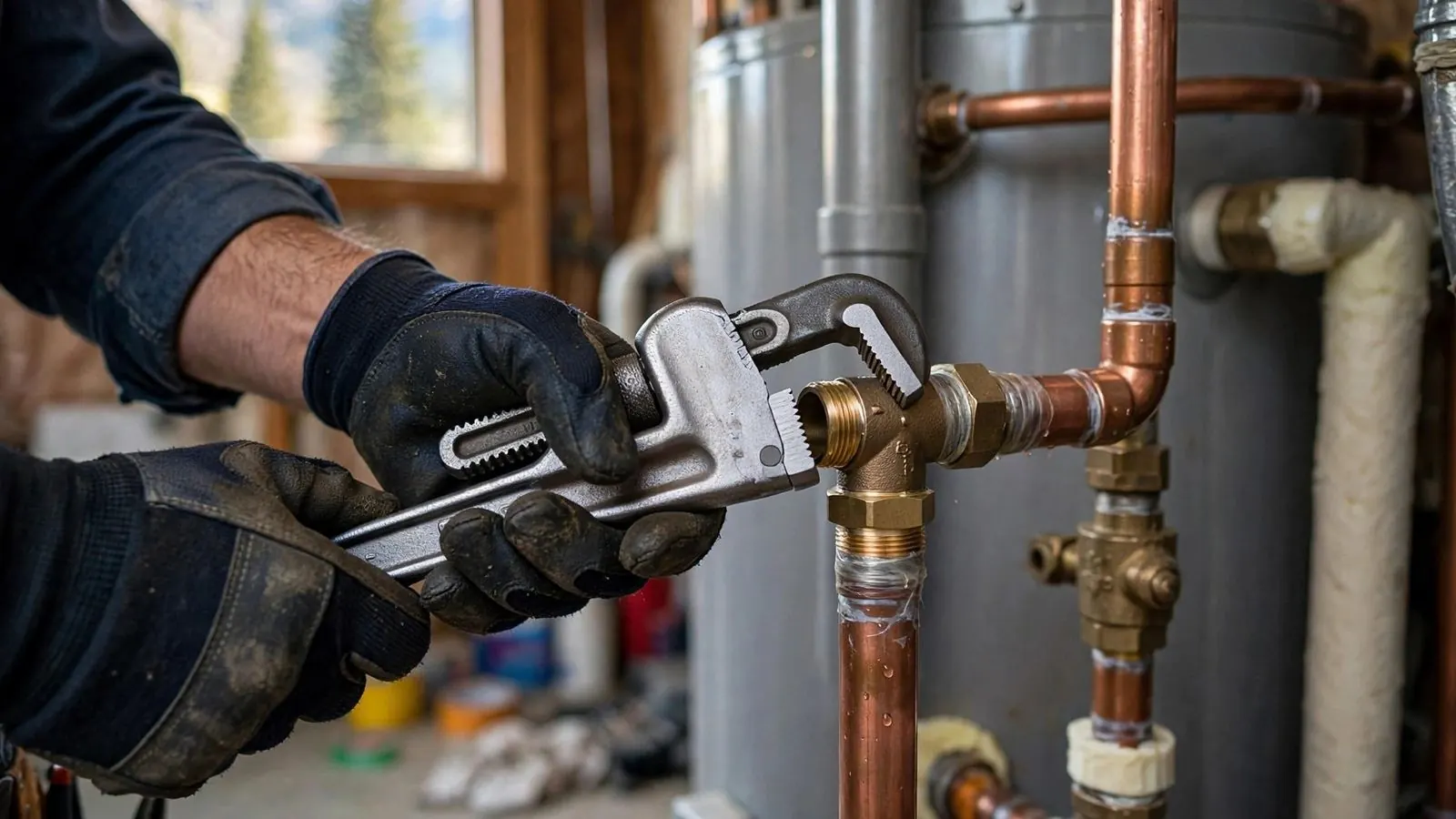
Water heater repair in Dolton, IL means finding the one failed part that is keeping a tank from heating or holding water, and fixing it if the tank itself is still sound. Our 24/7 emergency line is answered nights, weekends and holidays, because a heater that quits at 6 a.m. in January cannot wait for office hours.
If water is spreading, close the cold supply valve on top of the tank first. If you smell gas, skip everything else and follow the gas steps below. Then call our Dolton dispatch line and tell us what you see.
No hot water or a leaking heater right now
Do these in order. None needs tools beyond your hands and, for the drain step, a garden hose.
Close the cold water valve
It sits on the pipe entering the top of the tank. Turn the handle until it stops. A tank that cannot refill cannot keep leaking for long.
Cut the fuel
On an electric unit, switch off its breaker so the elements are not energized in a half-empty tank. On a gas unit, turn the gas control knob to OFF or PILOT.
Leave hot water alone
Water in the tank can run well above 120 degrees. Do not open the drain valve while it is hot, and keep children away from the puddle.
Move what the water can reach
Lift boxes, cardboard and a dehumidifier off the floor. If water is near an outlet or the panel, stay out and call us from upstairs.
Note the leak location
Top, side, bottom, or a drip from the small pipe beside the tank. That detail tells us whether we are bringing a part or a new unit.
If you smell gas near the heater, leave first
A rotten-egg smell near a gas water heater is not a repair call yet. Do not look for the source, and do not flip switches or use your phone inside. Walk everyone outside, then call Nicor Gas at 888-642-6748 or 911, and stay away until they say it is safe.
Call us after the gas utility has cleared the house. We never work on a gas connection while there is an active smell, and we cannot promise how fast any utility arrives, so do not wait indoors for anyone.
Where the water is coming from
A wet floor does not always mean a dead tank. This table shows how we separate a cheap fitting from a failed shell.
| Where it drips | Usual cause | Repairable? |
|---|---|---|
| Pipe connections on top | Loose or corroded supply fitting | Yes, often a short repair |
| Small pipe from the relief valve | Valve opening from pressure or heat | Yes, but find out why it opened |
| Drain valve near the bottom | Worn valve seat or sediment | Usually yes, replace the valve |
| Seam or base of the tank | Rusted shell from the inside out | No, the tank has failed |
| Wet inside the burner or element panel | Leak above, condensation or a failed tank | Depends, we open it and check |
Why there is no hot water
Each fuel type fails in its own way. Here is what we test first.
Pilot will not stay lit
On a standing-pilot gas unit, a dirty pilot tube or a weak thermocouple lets the flame die. Both are small parts.
Gas control valve fault
The valve is the thermostat and safety shutoff in one body. When it fails, we explain it and replace it rather than coaxing it along. Never open one yourself.
Burned-out electric element
Electric tanks have an upper and a lower element. One dead element gives lukewarm water or short hot showers. We test each with a meter.
Tripped high-limit switch
A red reset button on an electric unit trips when the water overheats. If it trips again after you press it, something is failing and it needs a visit.
Sediment on the tank floor
Hard minerals settle and insulate the burner or cover the lower element. Dolton hardness is not published, so test your tap before assuming anything.
Dip tube or mixing problem
A broken cold-water dip tube sends cold water to the outlet, so the hot supply runs out fast even though the tank is hot.
Heater down tonight?
Call the 24/7 line and tell us gas or electric, and where the water is.
The temperature and pressure relief valve is a safety part
That brass valve on the side of the tank with a pipe running down is the temperature and pressure relief valve, or T&P valve. It opens if the tank gets too hot or too pressurized. If it drips or spits, do not cap it, plug it or screw the discharge pipe shut.
A valve that drips every few days can mean pressure from a closed system, a missing expansion tank, or a heater overheating. Replacing the valve without asking why it opened only resets the problem. We check house pressure with a gauge on a hose bib and report the number.
Repair it or replace it
A repair makes sense when the tank is sound. Here is the honest split.
Repair makes sense when
- The leak is at a fitting, valve or drain, not the shell
- The failed part is an element, thermocouple, thermostat or relief valve
- The tank is young and has a clean inside
- The fix costs far less than a new unit
Replace instead when
- Water seeps from the tank body or its base
- The heater is over 10 to 12 years old and has needed several repairs
- Rust-colored hot water points to a corroded interior
- A control valve plus a second failure costs close to a new unit
If the shell has failed, our water heater replacement page explains sizing and what happens on install day. Planning ahead instead? See water heater installation.
What to tell us on the phone
A few details help the dispatcher bring the right parts on the first trip.
- Gas or electric, and roughly how old the unit is, from the label on the tank
- The tank size, usually printed in gallons on the same label
- Where it sits: basement, closet, garage or utility room
- Whether you see water, rust stains, scorch marks or hear popping
- Whether the pilot is out or the breaker is tripped
What drives the cost of a heater repair
We give you the price after we diagnose and before any part goes in. These factors move it.
Homeowners policies often treat a sudden leak differently from long-term seepage, so ask your agent. Want your real number? Call (773) 207-0518.
After a basement flood, do not relight the heater
Cook County's hazard mitigation plan describes repeated basement flooding in parts of Dolton. If water reached your heater's burner area or its controls, do not relight a pilot or flip the breaker back on. Wet controls can fail in ways you cannot see.
Call us to inspect the unit first. Floodwater also brings sewage and silt, so we also check what else in the basement needs attention. See sump pump repair if the basement keeps taking on water. We also work in Harvey, a few miles west.
Safety guidelines that apply to water heater repair
A water heater mixes water, gas or high-amperage electricity and a pressure relief valve, so a few guidelines are not optional. Nicor Gas guidance says to leave the building and call 888-642-6748 or 911 if you smell gas, and the relief valve discharge should never be capped or plugged.
The Illinois Plumbing Code, 77 Ill. Adm. Code 890, covers the water connections, and the manufacturer's manual covers the gas and electrical parts. We follow both, and we tell you when the age of the tank makes a repair poor value.
Sources: Nicor Gas customer guidance, 77 Ill. Adm. Code 890, manufacturer manuals.
Water Heater Repair questions in Dolton, IL
Yes. The dispatch line is open 24/7, including holidays. Call (773) 207-0518, say whether the heater is gas or electric and whether water is leaking, and we will book the first available appointment for your address.
If the unit has a printed lighting procedure on its label and you smell no gas, many owners do. If it will not stay lit, if you smell gas at any point, or if the area is damp, stop and call. A failing pilot is a symptom, not the cause.
No. The valve is the last safety if pressure or temperature climbs. Capping it removes that protection. Call us to test the pressure and the thermostat setting.
On an electric tank that usually points to one dead element. On gas it can be a dirty burner or a thermostat out of range. Both are repairable if the tank is sound.
Dry the tank and the connections with a towel, then watch. Wetness returning at the bottom edge or seam means the shell has rusted through. Wetness at a pipe joint or valve is usually fixable.
Often. Those noises come from sediment cooking under the water. A flush may quiet it, but a heavy buildup on an old tank can mean the unit is near the end.
We look at them, and parts availability on newer models varies by brand. Tell us the model from the label when you call so we can plan.