
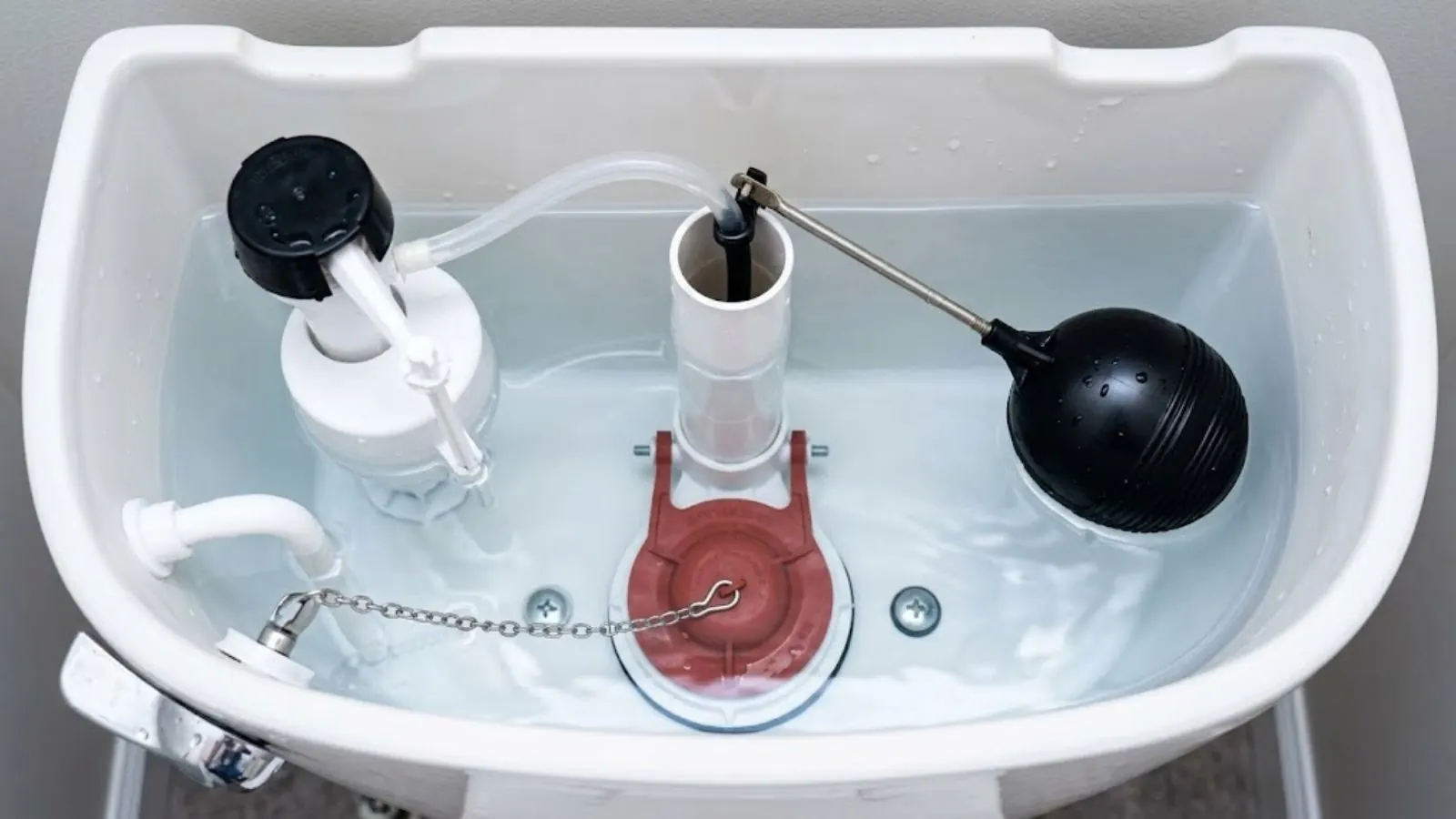
Emergency toilet repair in Dolton, IL covers a toilet that is overflowing, leaking at the base, running without stopping, or rocking loose on the floor. Our 24/7 emergency line is answered nights, weekends and holidays. If water is rising now, reach behind the bowl, turn the supply valve clockwise until it stops, then lift the tank lid and press the flapper down. That buys you time for the call.
Almost every toilet problem is one of three things. A tank part has worn out, the seal under the bowl has failed, or the drain behind the bowl is blocked. They need different fixes, so a leaking toilet and a clogged toilet should never be treated the same way.
Toilet overflowing right now: what to do while you wait
Water on a bathroom floor travels fast, especially into the ceiling below. These steps take under a minute and need no tools.
Close the supply valve
It sits on the wall or floor behind the bowl. Turn it clockwise. If it is stuck or snaps, shut the main water valve instead and tell us.
Stop the tank from refilling
Lift the lid and hold the float up, or press the rubber flapper down over the drain opening. The bowl cannot overflow if the tank stops adding water.
Do not flush again
A second flush on a blocked drain just sends more water over the rim. Wait until we confirm what is blocked.
Contain and protect
Lay towels at the base, move rugs, and keep power cords and outlets clear of wet floor. If the water came from the bowl, treat it as dirty and wear gloves.
Check the room below
A stain or drip on the ceiling under the bathroom means water is moving through the floor. Tell the dispatcher so we plan for it.
A running toilet usually means one of five parts
A toilet that hisses, refills on its own, or needs the handle jiggled is wasting water around the clock. The cause is normally a worn part, and one visit usually settles it.
Flapper
The rubber disc that seals the tank. When it warps or collects mineral crust, tank water leaks into the bowl and the fill valve restarts every few minutes.
Fill valve
The tall assembly that refills the tank. A worn seal inside keeps it hissing or lets water creep past the shutoff point.
Float height
If the float sits too high, water spills down the overflow tube. Lowering it is sometimes the only fix needed.
Chain or lift arm
Too much slack under the flapper chain prevents a clean seal. Too little holds the flapper open.
Overflow tube
A cracked tube or a refill hose clipped at the wrong angle drains the tank slowly and goes unnoticed.
Clog or main line backup? Read the clues
One stuck toilet is a small job. A toilet that reacts to other drains in the house is a bigger one. Use the table to describe it on the phone.
| What you see | What it usually means | How we approach it |
|---|---|---|
| Only this toilet is slow, plunger helps | Blockage in the bowl trap | Closet auger, no need to pull the toilet |
| Toilet clogs again within days | Something lodged past the trap, or a partial blockage | Auger first, then pull the toilet and look |
| Bubbling when the shower or washer drains | Branch or main line restriction | Machine cable, then camera if needed |
| Basement floor drain is wet, toilet gurgles | Main line backup | Cleanout access and camera inspection |
| Every toilet in the house is slow | Main line or vent problem | Stop using water and call the 24/7 line |
Toilet leaking or overflowing?
Call the 24/7 line and tell us whether the water is coming from the tank, the base or the bowl.
Water around the base: the wax ring and the flange
A toilet sits on a wax ring pressed between the bowl horn and the floor flange. When that ring is crushed or the toilet has been allowed to rock, a thin film of water seeps out at the base on every flush. Floors under vinyl and tile can rot for months before anyone sees a stain.
Pulling the toilet to replace the ring is also our chance to inspect the flange. A cracked or corroded flange, or one sitting below the finished floor, cannot hold a new ring tight. We tell you what we see before we reset the bowl, and a flange repair ring or a new flange is a separate, clearly quoted step.
A toilet that moves when you sit on it is a warning. Loose closet bolts or a failing seal are easy to fix early and costly to fix once the subfloor is soft.
Fix the toilet you have or replace it?
Repairs make sense far more often than people expect, but not every toilet is worth the parts.
Repair it when
- The bowl and tank are sound and the problem is a flapper, fill valve or wax ring
- The flush works well and only the refill is wrong
- You like the height and look of the toilet
- The toilet has not needed repeated service visits
Replace it when
- The porcelain is cracked at the tank, bowl or base
- It clogs often even with a clear drain line
- Internal parts are no longer made for that model
- You want a taller bowl or a toilet that flushes with less water
A cracked tank or bowl is never repaired with epoxy, because the crack will open again under load. If you decide to swap, our plumbing installation crew handles the supply line, shutoff valve and floor fit in the same visit.
How a replacement toilet goes in
Whether you bought the toilet or want help choosing, the sequence is the same.
Shut off and empty
We close the supply, flush the tank, and sponge the bowl dry so the toilet lifts cleanly.
Pull the old toilet and inspect
The flange, closet bolts and the floor around them are checked for cracks, rust or soft spots.
Set the new ring and bowl
We confirm the distance from the wall to the flange bolts, since 12 inches is common but not universal, then set the bowl level and snug the bolts evenly.
Connect and test
We attach a new supply line, flush several times, and watch the base and the supply joint for seepage.
Where we work and what to know first
We work out of 1205 E Sibley Blvd and cover ZIP 60419 in Dolton, along with nearby Riverdale and Harvey. Landlords can give us a unit number and a contact who can open the door.
If the water behind the bowl is brown or the floor drain nearby is wet, say so on the call. That points to the line rather than the toilet, and our drain cleaning work covers it. Permit rules vary, so ask the Dolton building department before moving a toilet to a new spot.
Fit, flange and code guidelines for toilets
A 12 inch rough-in, measured from the wall to the center of the flange bolts, is the common standard, and a toilet has to match it. Buying the wrong rough-in is a classic reason a swap becomes a second trip.
The Illinois Plumbing Code, 77 Ill. Adm. Code 890, governs how a toilet is connected and vented. Permit rules vary, so ask the Dolton building department if you are moving a toilet rather than replacing one.
Sources: standard toilet rough-in dimensions, 77 Ill. Adm. Code 890.
Toilet Repair questions in Dolton, IL
Yes. The line is open 24/7. Call (773) 207-0518, tell us whether the toilet is overflowing, leaking or running, and we will book the first appointment available for your address.
The flapper is not sealing, the float is set too high, or the fill valve is worn. Drop a little food coloring in the tank. If color shows up in the bowl without flushing, the flapper is the culprit.
Not always, but it should not wait long. A rocking toilet strains the wax seal and can start a slow leak into the subfloor. Stop using it if you see water at the base.
If other fixtures gurgle, or a basement floor drain is wet when you flush, the problem is deeper than the bowl. A single slow toilet with every other drain normal is almost always local.
Permit rules vary, so ask the Dolton building department, Housing and Permits, at 708-201-3261. Moving the toilet to a different spot is more likely to raise the question than a like-for-like swap.
Yes. Keep the box and measure the rough-in distance from the wall to the flange bolts first. A toilet built for a 10 or 14 inch rough-in will not sit right on a 12 inch flange.