
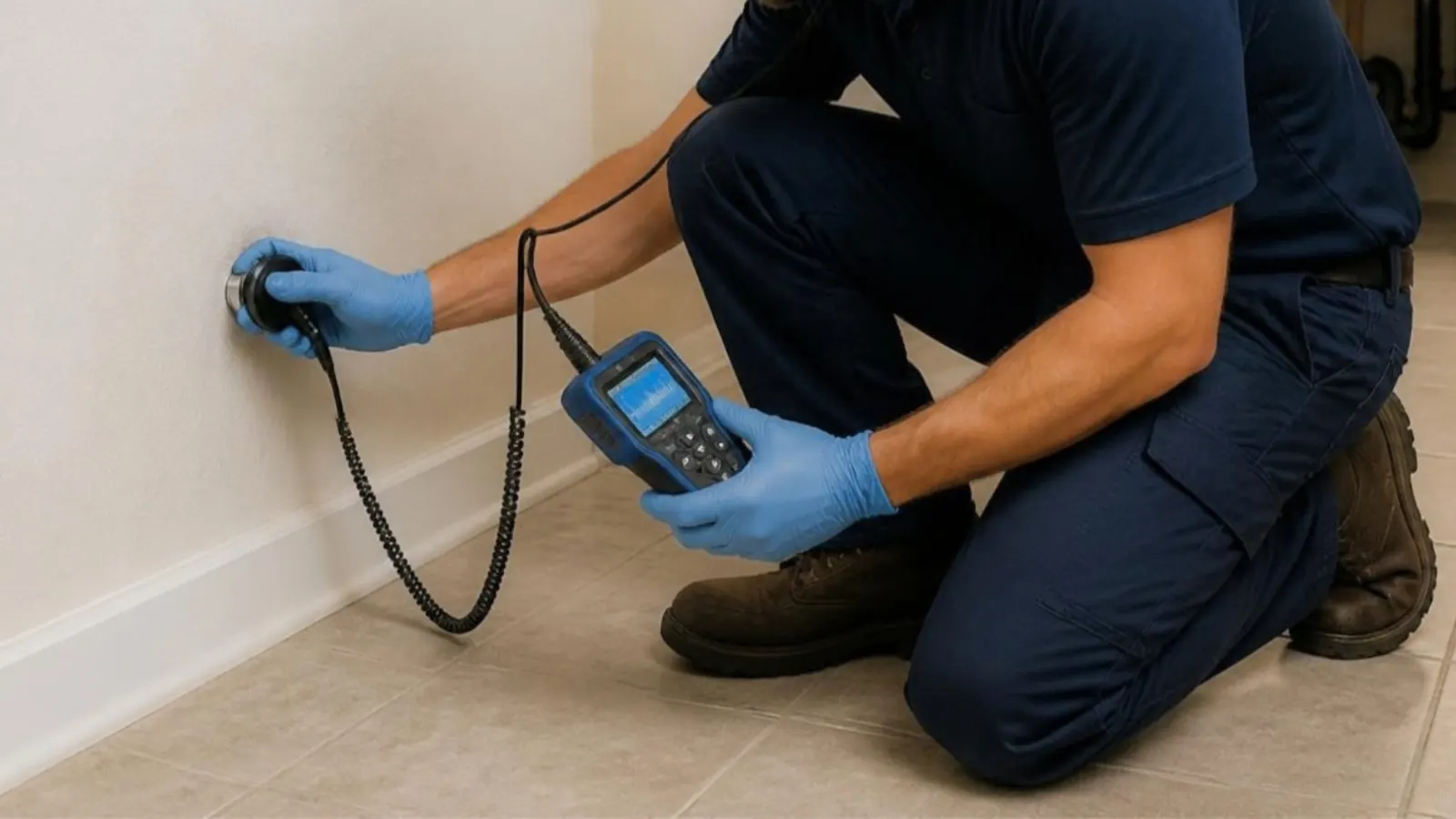
A water heater leak detection system is a device that senses water near the tank and either warns you or closes a valve to stop the flow. In a Dolton, IL basement, the heater often sits on a slab near a floor drain, which hides a slow drip until the carpet or storage boxes are wet. The device you pick depends on whether you want an alert or you want the water stopped without you.
Neither type fixes a tank. They shorten the time between a leak and your reaction to it, and that is the whole job.
Three types of leak protection compared
Prices vary by brand, so this table compares behavior only.
| Type | What it does | Needs power or Wi-Fi | Main limit |
|---|---|---|---|
| Battery leak alarm | Sounds a local beep when the sensor gets wet | Battery only | Useless if nobody is home to hear it |
| Smart sensor with app | Sends a phone alert, often with a temperature reading | Wi-Fi and batteries | Alerts you but does not stop water |
| Auto shutoff valve with sensor | Closes the cold supply to the heater when it detects water | Power, sometimes Wi-Fi | Needs installation and the right pipe size |
| Whole-house flow monitor | Watches for unusual flow and closes the main valve | Power and Wi-Fi | Installed on the main line and set up by a plumber |
Alerts versus automatic shutoff
A sensor is a puck with two metal contacts. When a film of water bridges them, it fires an alarm. A smart sensor adds a phone message. That works if you are home, awake and near your phone.
An auto shutoff valve adds a motorized valve on the cold supply to the heater. If a leak trips the sensor, the valve closes and the tank stops refilling. That limits the flood to what is already in the tank and on the floor.
We lean toward shutoff for a heater in a finished basement or for a house left empty during a work week. For a heater next to a floor drain in an unfinished utility room, a good smart sensor may be enough.
Leak under your water heater?
Call the 24/7 line. If the tank is leaking, we will tell you how to stop it while we are on the way.
What to confirm before you buy any device
Most disappointments come from mismatched parts, not bad brands.
- The size and type of your cold supply pipe, whether copper, PEX or something else
- Whether the shutoff valve can be installed ahead of the heater and its expansion tank
- Where the sensor will sit, which must be the lowest point near the tank
- Whether your basement Wi-Fi reaches the heater location
- Whether the pan under the heater drains to a floor drain or to nothing
- Whether your home insurance agent has a view on leak shutoff devices
What these systems cannot do
A sensor only detects water where it sits. A pinhole spray that hits a wall, a leaking relief valve discharge pipe that runs somewhere else, or a drip behind the tank will not wet the puck until the damage is already done. Sensors also depend on batteries, and a dead battery is a silent failure.
A shutoff valve stops supply water. It does not drain a full tank and it does not prevent a tank from rupturing. If the water leaves the tank itself, you still need a plumber and a new tank.
No device makes an old tank safe. A water heater that is seeping at the seams or has rust at the base is a replacement job, and a detector only tells you when it quits.
Why a basement sensor matters in Dolton
The Cook County hazard mitigation plan describes urban and repetitive basement flooding across entire Dolton neighborhoods, including the Cornell area and the 158th and Greenwood corridor. A leak sensor near the water heater is not a flood alarm for sewer or storm water, but it does give you a second set of eyes on a basement that already has a reputation for wet floors.
Check what your insurance covers. The Illinois Department of Insurance says basic homeowners policies do not cover floods, and standard flood coverage does not typically cover sewer backup, so ask your agent about the difference between a leaking appliance and a backed-up drain.
Source: Cook County hazard mitigation plan annex for Dolton, 2024, and Illinois Department of Insurance consumer guidance.
How we install a heater shutoff setup
The install is simple in theory and fussy in practice.
Find the right spot
The valve goes on the cold line feeding the heater, with room for the actuator and a way to reach it by hand.
Cut in and connect
We shut off the water, drain the line, install the valve and fittings, and check each joint under pressure.
Place the sensors
Sensors go at the floor level beside the tank and in the drain pan. We test each one with a few drops of water.
Test the shutoff
We trip the system on purpose and confirm the valve closes. Then we show you how to reopen it and how to test it monthly.
When a replacement tank is the better answer
If the heater is leaking now, do not add a sensor. Shut the water to the heater, turn the gas or power to off, and call us. We look at the tank, and if the leak is from the body, replacement is the honest advice. Our leak detection work finds the source when it is not obvious, and our water heater replacement service handles the swap.
A new heater with a drain pan, a discharge line to a drain and a shutoff valve is a good pairing. We discuss sizing and warranty during the visit.
Serving homes beyond the village line
We take water heater calls in Dolton and in Calumet City and Harvey. Wherever you are, the first step with any tank leak is the same. Cut the water, kill the power or gas and call.
Questions readers ask
Place it on the floor right beside the tank, or in the drain pan if you have one. Water runs downhill, so the lowest point near the heater catches a leak fastest.
Most do not. They send an alert. To stop water automatically you need a motorized shutoff valve that works with the sensor.
No. It tells you there is water. A plumber finds the source, which may be a fitting, the relief valve, the drain valve or the tank body.
Battery sensors keep working. A powered shutoff valve may need a battery backup, so read the specs. Dolton's hazard plan lists power outages as a typical impact of severe storms.
For a valve cut into the supply line, yes. Plain sensors you can place yourself, but a plumber should connect any valve.
A steady leak from the tank body is. Turn off the cold supply to the heater and the power or gas, then call. A small drip from a fitting can often wait for the next available slot, but ask us.