
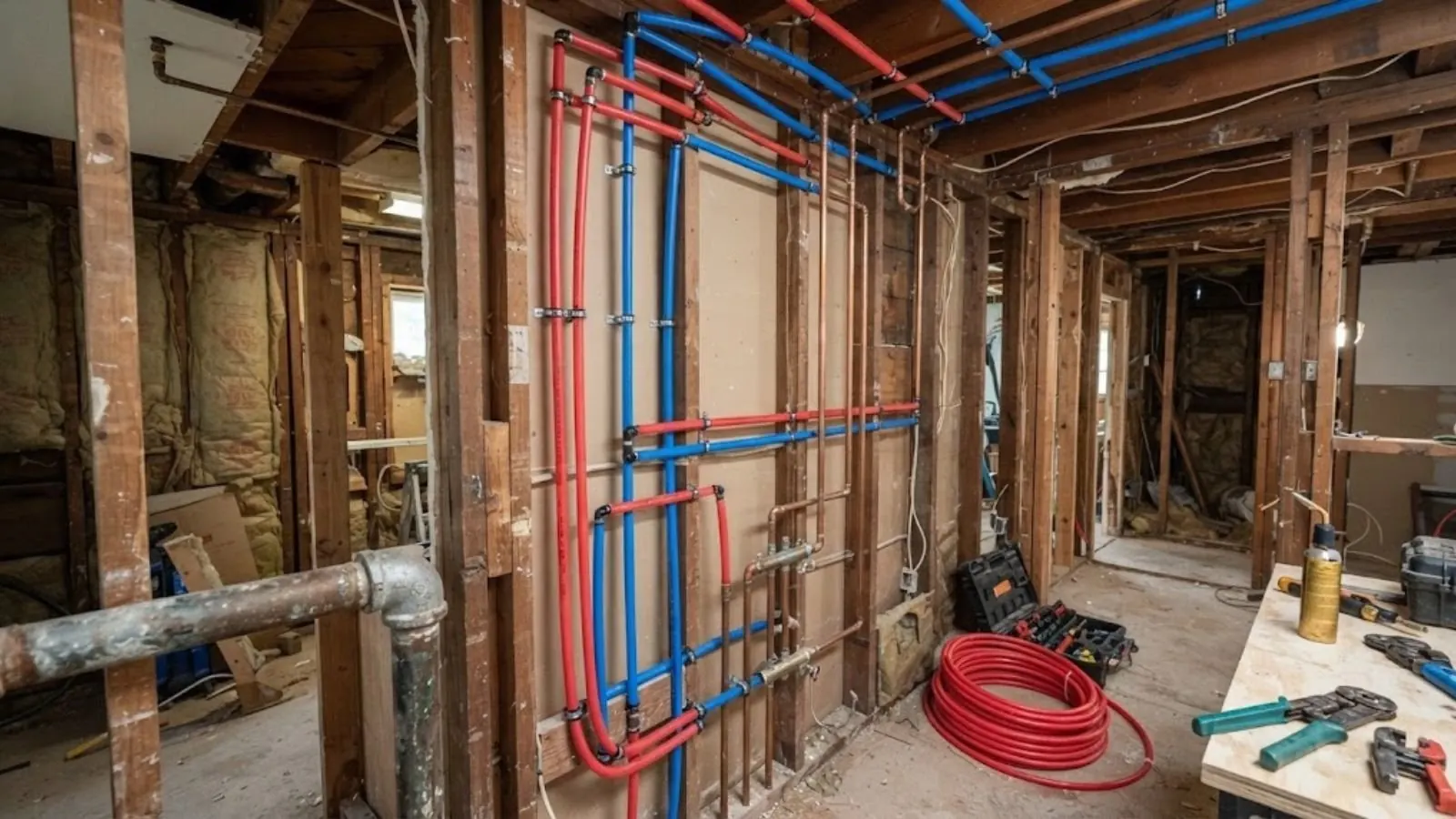
Plumbing types of pipe fall into two jobs. Supply pipes carry clean water in under pressure, and drain pipes carry waste out by gravity. The materials differ because the jobs differ, and a Dolton, IL house can hold three or four materials at once after decades of repairs.
This guide shows how to recognize each one, what it is used for, and what it tends to do when it gets old. We do not know which materials your home has, because that depends on when it was built and what has been replaced.
The common pipe materials side by side
Use this as a field guide. Color and fittings help most, and the notes tell you where each type usually runs.
| Pipe | Used for | How to spot it | Typical weakness |
|---|---|---|---|
| Copper | Supply lines | Orange-brown, soldered joints | Pinhole leaks, green corrosion |
| PEX | Supply lines | Flexible red, blue or white tubing | Sunlight damage, crimp fitting leaks |
| PVC and CPVC | Drains and some supply | White or cream plastic, glued joints | Cracks when brittle or stressed |
| ABS | Drains | Black plastic, glued joints | Cracks, softens with heat |
| Cast iron | Main drains and stacks | Heavy gray or black, bell-and-spigot joints | Rust scale, cracking, root entry |
| Galvanized steel | Older supply lines | Gray, threaded fittings, rusty rings | Internal rust, low pressure |
How to tell what you have without opening a wall
A few simple checks from the basement or under a sink tell you most of what you need.
Magnet test
A magnet sticks to galvanized steel and cast iron but not to copper, PEX or plastic. Hold it against the pipe, not a fitting.
Scratch test
Scrape a small spot with a key. Copper shows shiny orange. A soft, dull gray metal that scratches easily may be lead.
Look at the joints
Soldered silver rings mean copper. Threaded ends point to steel. Glue stains and smooth couplers point to plastic.
Read the markings
Plastic pipe is often printed with its type and size. Look at the wall of the pipe near a hanger or fitting.
Check the water meter side
The pipe coming in from outside, at the meter, may be your service line. Note the material and photograph it.
Not sure what is in your walls?
We can look at your supply and drain lines and explain which sections are worth keeping.
Why lead matters in the Dolton conversation
The Village of Dolton's 2025 Consumer Confidence Report lists a lead 90th percentile of 10.7 ppb against an action level of 15 ppb, with 3 sampled sites over the action level. The report says lead in drinking water comes mainly from service lines and home plumbing, and that the village has developed a service line material inventory.
The report does not publish how many lines are lead. So ask the Dolton Water Department at 708-201-3293, or Public Works at 708-201-3280, what material your service line is. If you find lead or you are unsure, ask your plumber about testing and replacement options before you run any repipe.
Source: Village of Dolton Consumer Confidence Report, 2025.
Supply lines: copper, PEX and the older steel
Copper has been used for supply lines for generations. It handles heat well, but acidic water, high flow and bad solder can cause pinholes. A pinhole leak sprays a fine mist that stains the ceiling below before anyone sees a drip.
PEX is a flexible plastic tube that bends around corners with fewer joints. It is cheaper to run and resists freezing damage better than rigid pipe, but it is not for outdoor use in direct sun. Galvanized steel is older. It rusts from the inside, so pressure drops long before the pipe leaks.
Copper or PEX for a replacement
If you are repiping, these are the two choices most homeowners weigh. Both are accepted widely, but local rules govern which is allowed.
Copper
- Long track record in supply lines
- Rigid, so it needs more fittings
- Needs soldering by a trained tradesperson
- Can develop pinholes in aggressive water
PEX
- Flexible and fast to run through walls
- Fewer joints means fewer leak points
- Uses crimp or expansion fittings and special tools
- Not for sun exposure and not for hot burners
Which materials are allowed depends on the Illinois Plumbing Code, 77 Ill. Adm. Code 890, and local rules. Confirm with the Dolton building department before buying pipe. Our repiping page explains how a whole-house replacement works.
Drain lines: PVC, ABS and cast iron
Drains rely on slope, not pressure. Plastic pipe is smooth inside, so it resists buildup. Cast iron is quieter and was the standard for stacks and main drains in older homes, but it rusts and scales from the inside over decades.
A cast iron main with heavy scale slows flow and catches grease. A camera inspection shows the thickness of the scale and whether roots are entering a joint. We would rather show you the footage than tell you a pipe needs replacing.
When a pipe type means replace, not patch
A single repair on a healthy pipe is fine. Repeated leaks on the same line, brown water on first use, or low flow on every fixture suggest the pipe itself is failing. Patching one pinhole in copper that has many more developing is paying for the same trip again.
For a leak between the street and the house, see our guidance on water line repair. The service line is a separate decision from interior piping, and who is responsible for which section should be confirmed with Dolton Public Works.
Towns we serve near Dolton
Our shop is at 1205 E Sibley Blvd, and we cover ZIP 60419 and the neighboring towns. Homeowners in South Holland and Harvey often ask what pipe they have before buying a house or planning a remodel.
Landlords can call with the building address and the reason for the question. We can often schedule a same-day appointment when available, and we state the price before work starts.
Questions readers ask
Check where the pipe enters near your meter. A dull gray, soft pipe that a key scratches to shiny silver may be lead. Then ask the Dolton Water Department at 708-201-3293 what the village inventory shows for your address.
Not today, but it rusts inside over time. Falling pressure, orange water or small leaks are warning signs. Plan a replacement before it fails inside a wall.
Yes, with the right transition fittings. Mixing metals directly can cause corrosion, so use proper connectors and ask a plumber to do the joint.
No. Standard PVC softens with heat. CPVC is rated for hot water, and copper or PEX are the other common choices.
Permit rules vary, so ask the Dolton building department, Housing and Permits, at 708-201-3261 before work starts. Illinois plumbing work also follows the Illinois Plumbing Code.
The service line brings water from the village main to your meter or shutoff. House piping runs from there to fixtures. Ask Public Works at 708-201-3280 where the boundary sits for your property.