
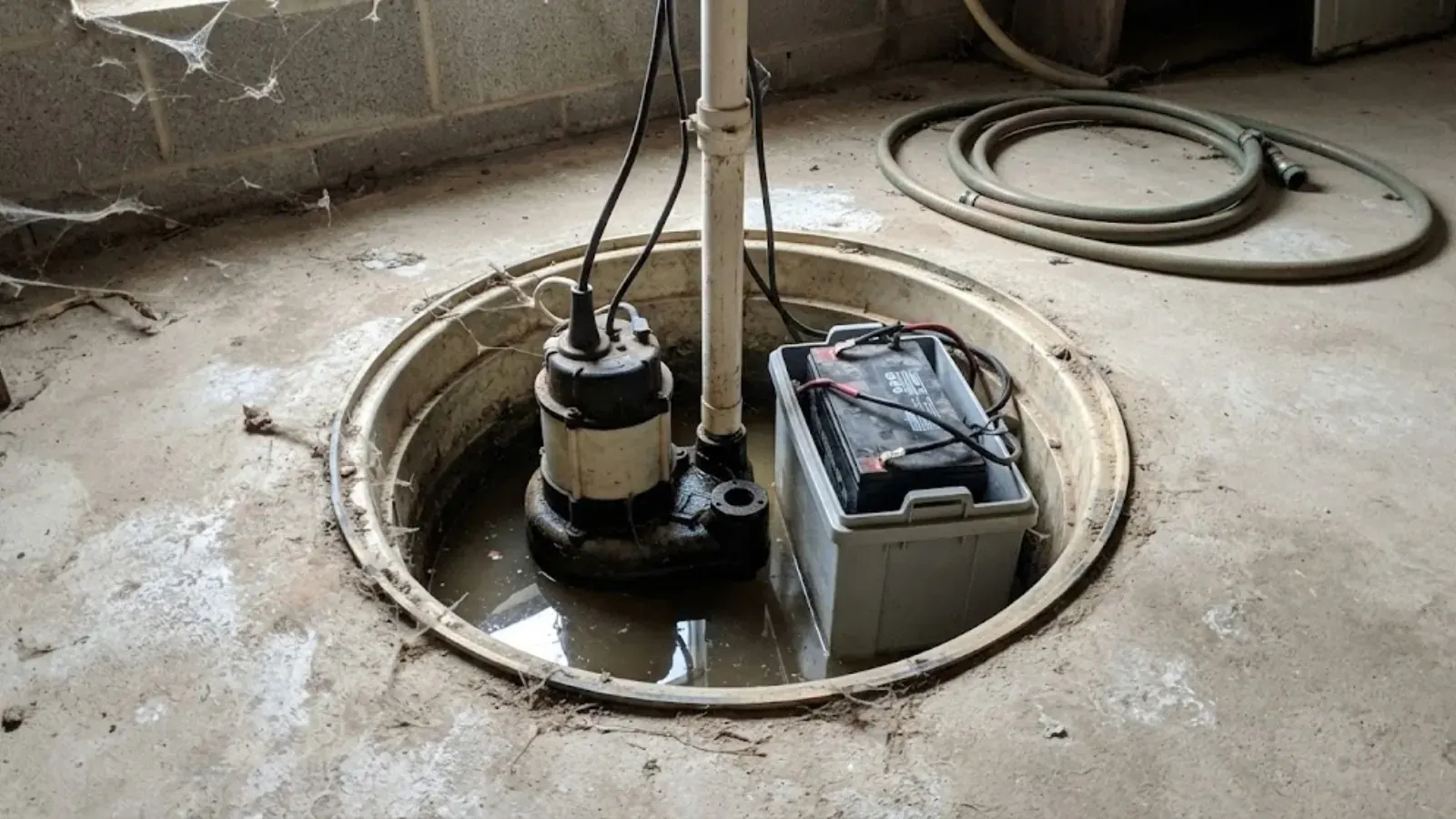
A sump pump is a small pump that sits in a pit in the lowest part of your basement or crawlspace. When groundwater fills the pit, a float switch turns the pump on and sends the water out through a discharge pipe. Sump pump installation in Dolton, IL has five parts: the pit, the pump, a check valve, a discharge line and a power plan.
This guide covers each part and the choices that matter. It also says what a sump pump does not do, because it does not stop sewer backup or fix a floor drain that overflows.
Why Dolton basements ask for a pump
Cook County's hazard mitigation plan for Dolton describes urban and repetitive basement flooding across entire neighborhoods, naming the Southern Corridor, the Cornell area and 158th and Greenwood. FEMA counts 34 repetitive-loss properties in the village. The plan also notes that annual precipitation averages about 36 inches, often in short, hard storms.
A pump helps with groundwater. It does not help when the sewer backs up through a floor drain, which needs a different fix. The Illinois Department of Insurance says standard flood coverage does not typically cover sump pump failure or sewer backup, so ask your agent about adding it. The department's hotline is 1-866-445-5364.
Sources: Cook County hazard mitigation plan, Dolton annex, 2024. Illinois Department of Insurance.
How the install goes, start to finish
A typical installation takes most of a day. Here is the order we follow.
Locate the pit and cut the slab
We pick the lowest spot and the shortest path to an outside wall. A concrete saw or jackhammer opens a hole about 18 inches wide, and we dig the pit about 24 inches deep.
Set the liner and the pump
A perforated liner goes in and gravel is packed around it. The pump sits on the bottom, level, so the float has room to move.
Connect the check valve and discharge
A check valve on the discharge stops water from falling back into the pit. The pipe runs through the rim joist to a discharge point away from the house.
Power, test and seal
The pump plugs into a grounded, protected outlet. We fill the pit with water, check the float cycle, then patch the slab around the lid.
Basement taking on water?
We can look at the floor, the likely pit spot and the discharge route and explain options before a price is set.
Submersible or pedestal pump
Both move water. They differ in cost, noise and how they handle a full pit.
Submersible
- Sits in the water, so it is quiet
- Handles heavy flow well
- Hard to service because it is under water
- Common in finished basements
Pedestal
- Motor sits above the pit
- Easier to reach and often cheaper
- Louder and sits in the way
- Best for small pits and light use
Which one fits depends on the pit and the usage. Our sump pump page covers replacement and repair.
What changes the cost of a pump install
The pump is only one piece. These factors move the total, and we give a clear price before work starts.
Ask your insurance agent whether sump pump failure is covered, since many policies leave it out. Want your real number? Call (773) 207-0518.
Pit, pump and discharge details that matter
Small choices decide whether a pump works in a real storm. Use this table as a checklist for any quote.
| Detail | Why it matters | What to ask |
|---|---|---|
| Check valve | Stops backflow into the pit | Is one included and where is it? |
| Discharge pipe size | Too small a pipe slows flow | What size is it and where does it end? |
| Where it drains | Water should leave the property away from the house | Is it kept out of the sanitary sewer? |
| Float switch | A stuck float stops the pump | Is it tethered and has room to move? |
| Backup | Storms often cut power | Is a battery backup planned? |
Power outages and storm planning
The hazard plan lists power outages among storm impacts, and nighttime thunderstorms are common in the area. A pump that depends on household power stops when the power does. A battery backup pump, set slightly higher in the pit, can keep running for several hours depending on the battery and the flow.
Test the pump twice a year by pouring a bucket of water into the pit. Listen for the pump to start and shut off, and check that water leaves the discharge outside. Keep the pit lid on and the area clear.
Discharge lines, digging and local rules
The discharge pipe should empty outside, well away from the foundation. Do not send it into the sanitary sewer, and ask the Dolton building department, Housing and Permits, at 708-201-3261 what rules apply, because permit rules vary. A pipe that dumps next to the house can send the water right back into the pit.
If the discharge line needs a trench, call JULIE at 811 at least 48 hours before digging so utilities are marked. It is free. Winter matters too, so ask about a freeze-resistant outlet that will not ice over.
What a sump pump will not fix
A pump will not stop a floor drain from backing up when the sewer fills. It will not seal foundation cracks or stop water coming through a wall. It will not help during a power outage unless there is a backup.
For seepage, cracks and wall moisture, a waterproofing system is a separate answer. See basement waterproofing for how drain tile and a sump work together. If a backup is the issue, ask about an overhead sewer or backwater valve, which is plumbing work and not a pump.
Serving nearby towns
From 1205 E Sibley Blvd we cover ZIP 60419 and neighboring towns. Homeowners in South Holland and Riverdale often ask about a pump after a wet spring.
We can often schedule a same-day appointment when available. The 24/7 emergency line is answered for flooding and failed pumps.
Questions readers ask
A common pit is about 24 inches deep and 18 inches wide, but the right size depends on the pump and the water. We measure the floor and the inflow before we cut.
Avoid it. A pump should have a dedicated, grounded and protected outlet. Cords can trip, overheat or get wet.
Not always. If your basement stays dry, a pump may not be needed. If you have had repeated seepage or standing water, a pump is worth discussing.
No. A pump handles groundwater. A sewer backup comes through floor drains and needs a backwater valve or an overhead system.
Permit rules vary, so ask the Dolton building department at 708-201-3261. Electrical work may need its own permit.
Twice a year is common, and before big storm seasons. Pour water into the pit and watch the float and the discharge.