
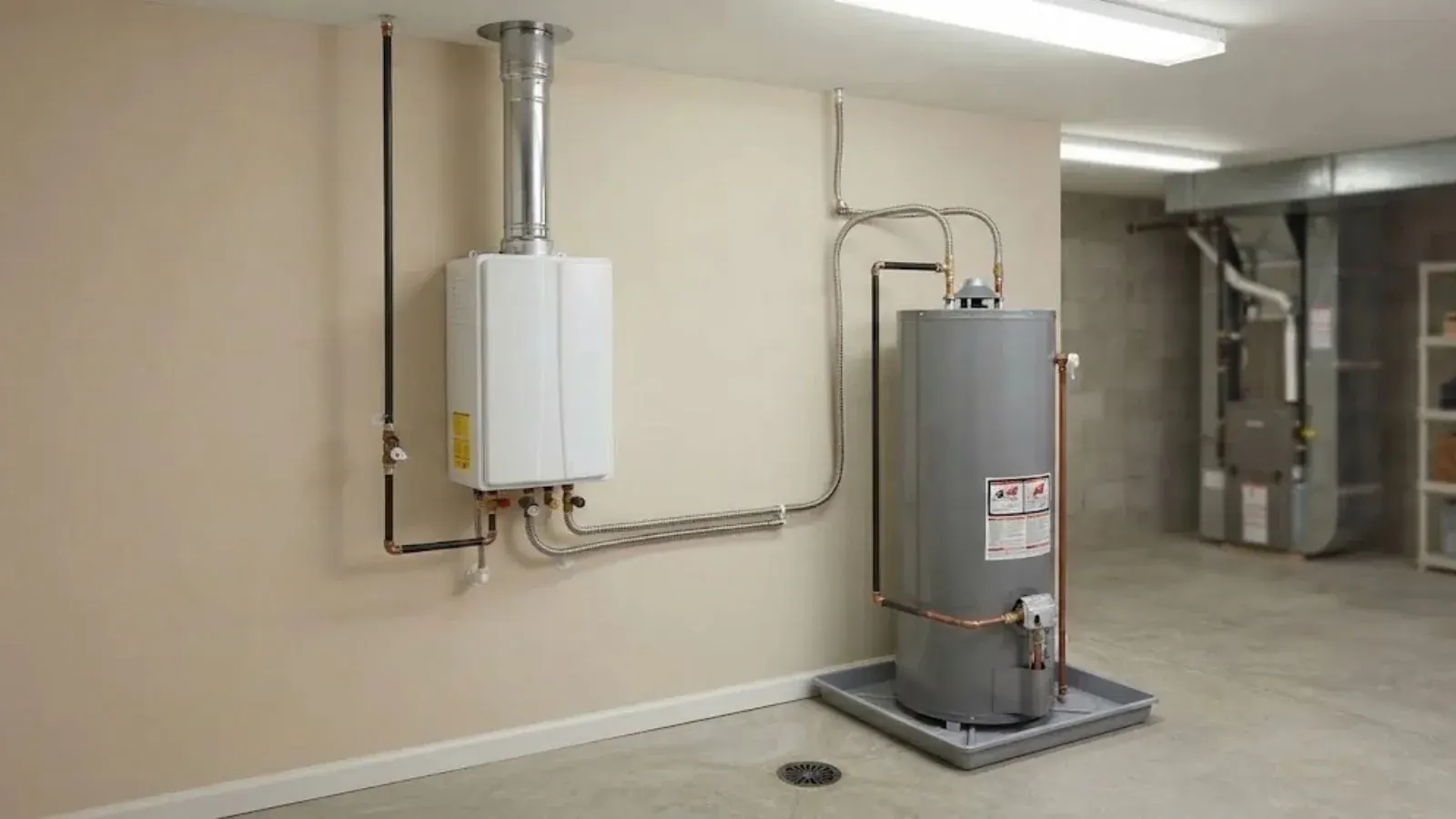
A tankless water heater heats water as it flows, using a burner or element that fires only when you open a tap. Plumbing one in a Dolton, IL home means connecting the cold supply, the hot outlet, a gas line or an electrical circuit, a vent to the outdoors, and often a drain for condensate.
Most of those connections are regulated. This guide explains each one so you understand a quote and ask good questions. It is not an instruction set for doing the gas and venting yourself.
What a tankless install includes and who should do it
Read the last column honestly. Several rows should not be a weekend project.
| Part of the job | What it involves | Who should do it |
|---|---|---|
| Water connections | Cold in, hot out, isolation valves with flush ports | Competent DIY or plumber |
| Gas supply | Sizing the line, shutoff, leak test | Licensed plumber |
| Venting | Sealed pipe for exhaust and intake air | Licensed plumber |
| Condensate drain | Neutralizer and a drain path for condensing units | Plumber |
| Electrical | Outlet or circuit for controls and fan | Electrician or plumber |
| Permit and inspection | Local rules vary | Confirm with the village |
The plumbing sequence in order
A good install follows a set order. These four stages are what we plan for.
Pick the location and size the unit
The unit needs a wall, a vent path and a gas line that can feed it. Flow rate and the winter inlet water temperature decide the size.
Run water lines with isolation valves
Cold goes in, hot comes out. Install a shut-off and a flush port on each side so the heat exchanger can be descaled later.
Connect gas, vent and condensate
The gas line may need to be larger than the one for a tank heater. A sealed vent leaves the building. A condensing unit needs a drain.
Test, fire and commission
Check every joint for leaks, check gas with a leak detector, set temperature, then confirm flow and venting before you leave.
Planning a tankless upgrade?
We can look at your gas line, vent path and water lines and explain the work before a price is set.
Gas line sizing is the step most often missed
A tankless unit can pull several times the gas a tank heater uses when it fires. If the gas pipe feeding it is too small, the unit will shut down or run poorly at full flow. Often the pipe from the meter needs to be upsized, and that has to be calculated, not guessed.
If you ever smell gas, leave the building. Then call Nicor Gas at 888-642-6748 or 911 before you call a plumber, and stay out until told it is safe. Do not touch switches or phones inside.
Condensing or non-condensing tankless unit
The type decides your venting material and whether you need a condensate drain.
Condensing
- Extracts extra heat from exhaust gas
- Uses plastic vent pipe, often PVC or CPVC
- Needs a condensate drain and neutralizer
- Often costs more up front
Non-condensing
- Exhaust stays hot and needs stainless vent pipe
- No condensate drain needed
- Vent material is more expensive per foot
- Usually a lower efficiency rating
Read the manufacturer's vent rules for the model you pick. Our tankless water heater page covers the install and the parts we handle.
Storms, outages and a gas heater that needs power
Cook County's hazard mitigation plan for Dolton ranks severe weather first and severe winter weather second. It describes nighttime thunderstorms and lists power outages among the impacts of storms. A tankless heater that burns gas still needs electricity for its fan, controls and ignition.
That means no hot water during a power cut unless you plan a backup. Ask the installer about a backup plan, and keep a flashlight near the unit. Also ask the Dolton building department, Housing and Permits, at 708-201-3261, what is required before work starts, because permit rules vary.
Source: Cook County hazard mitigation plan, Dolton annex, 2024.
Questions to ask before you hire anyone
Use this list with any plumber, including us. A clear answer to each is a good sign.
- Is the plumber licensed? Check IDPH License Verification for the plumber and the contractor
- Will the gas line be sized for this exact unit?
- Where will the vent terminate, and how far from windows?
- Where does the condensate drain go?
- Is a permit needed, and who pulls it?
- Will you flush and descale the unit later, and are isolation valves included?
What you can do yourself and what you should not
A competent homeowner can handle water connections in some cases, such as installing isolation valves on a replacement unit when the lines are already in place. That still needs correct fittings and a leak test.
Do not run or modify gas lines, make vent connections or wire a circuit yourself. Mistakes there cause carbon monoxide, gas leaks and fires. Illinois licenses plumbers through the Illinois Department of Public Health under the Plumbing License Law, 225 ILCS 320, and the Illinois Plumbing Code, 77 Ill. Adm. Code 890, governs the work.
A common mistake: expecting endless hot water to be free
Tankless units do not run out because there is no tank, but they do have a flow limit. Run two showers and a dishwasher together and a small unit will struggle. Winter water is colder, and the unit has to work harder to reach the temperature you set.
That is why sizing matters more than brand. Tell the plumber how many fixtures run at once, and ask about the temperature rise the unit is rated for. For a straight swap of a tank, see water heater installation.
Water line details that save trouble later
Use full-size piping on the cold and hot connections, usually three-quarter inch, so the unit is not starved of flow. Add a pressure relief valve and a discharge pipe run to a safe point, and install a sediment filter if your tap water carries grit. Keep unions or flex connectors near the unit so it can be removed.
Mark the isolation valves with tape or a tag. When the unit is serviced years from now, whoever opens the panel will know which valve is which. A tidy installation also makes it easier to compare quotes, because you can ask each plumber what is included.
Serving nearby towns
From 1205 E Sibley Blvd we cover ZIP 60419 plus the nearby towns. Homeowners in South Holland and Calumet City call us to size a tankless unit before they buy one.
We can often schedule a same-day appointment when available, and we state the price before work starts.
Gas, venting and electrical standards for a tankless install
A tankless heater has three systems that all have rules. Gas piping and venting follow the manufacturer's instructions and the National Fuel Gas Code (NFPA 54) as adopted locally, the water side falls under the Illinois Plumbing Code (77 Ill. Adm. Code 890), and any electrical supply follows the National Electrical Code (NFPA 70).
Permit rules vary, so ask the Dolton Housing and Permits office at 708-201-3261. If you smell gas at any point, leave the building and call Nicor Gas at 888-642-6748 or 911.
Sources: NFPA 54, NFPA 70, 77 Ill. Adm. Code 890, Nicor Gas customer guidance.
Questions readers ask
Sometimes, but often it needs a larger one. A plumber measures the run length and fixtures, then calculates what the unit needs at full fire.
Most gas models need electricity for the fan and controls, so they stop when the power goes out. Ask about a battery or generator backup.
A flush port is a pair of valves that lets you pump descaling solution through the unit. Without it, cleaning means cutting pipe. We include isolation valves on installs.
Permit rules vary, so ask the Dolton building department, Housing and Permits, at 708-201-3261 before work starts.
The water connections might be within reach, but gas, venting and wiring should be done by a licensed professional. Illinois plumbers are licensed through IDPH, and you can verify any license online.