
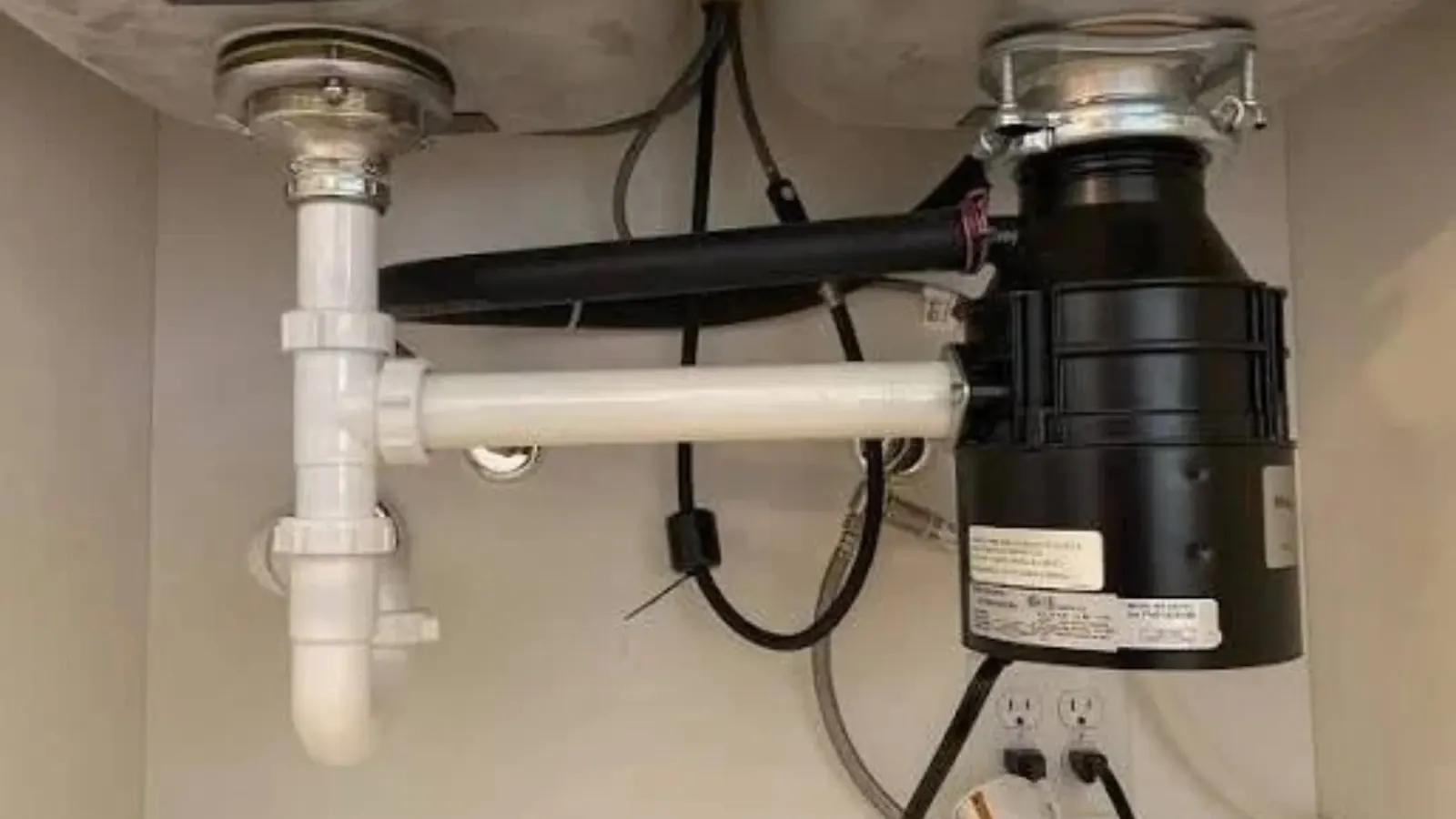
A garbage disposal bolts to the underside of your kitchen sink drain and grinds food scraps small enough to wash into the house drain. To plumb a garbage disposal in a Dolton, IL kitchen, you seal the sink flange, hang the unit from a mounting ring, connect the discharge pipe to the trap, and hook up the dishwasher hose if you have one.
That is the plumbing. The power connection is a separate task with its own safety limits, and we cover it below.
What you need on the bench before you start
Gather everything first. A missing part midway through means a second trip with the sink torn apart.
The disposal and its mounting kit
Most units ship with a mounting ring, gasket, snap ring and bolts. Read the instructions for your model.
Plumber's putty or a gasket
This seals the sink flange to the sink. Skip silicone unless the maker says so.
Discharge tube and slip nuts
A short tube connects the disposal outlet to the trap. Cut it to fit, and use new washers.
A dishwasher drain hose connection
The disposal has a small port for the dishwasher hose. It comes plugged.
Basic tools
Screwdriver, channel locks, a hacksaw or tubing cutter, a bucket and a towel.
The install in four stages
Clear out the cabinet under the sink and put a bucket under the trap. Allow two to three hours.
Remove the old drain and set the new flange
Take out the old strainer. Roll a rope of plumber's putty around the new flange, press it into the sink hole, and tighten from below. Wipe off the squeeze-out.
Hang the disposal
Slide the mounting ring, gasket and snap ring onto the flange, then lift the unit and twist it to lock. Rotate it so the outlet faces the trap.
Knock out the dishwasher plug
Use a screwdriver and hammer to knock out the plug inside the dishwasher port, then fish out the plug. Skip this and the dishwasher will not drain.
Connect the discharge and trap
Attach the discharge tube to the disposal outlet, align it with the trap arm, and tighten the slip nuts. Fill the sink, run water, and check every joint for drips.
Fighting with a trap that will not line up?
We install disposals and can set the drain, trap and dishwasher connection so they do not leak.
The dishwasher knockout is the step people forget
Inside the dishwasher port on the side of the disposal is a thin plastic plug. If you leave it in, dishwasher water has nowhere to go, and it backs up into the dishwasher. The symptom shows up days later as a dishwasher that finishes a cycle with a standing puddle.
Knock the plug out with a screwdriver and fish it from the grinding chamber. Then run the dishwasher hose up into a high loop under the sink before it connects, to stop wash water siphoning back. Check the instructions for your dishwasher.
Leak points and how to spot them
Disposals leak in a few predictable spots. Dry the area, run water, and use a paper towel to find the drip.
| Where it leaks | Likely cause | Fix |
|---|---|---|
| Under the sink flange | Putty gap or loose mounting ring | Reseat the flange with fresh putty |
| Between disposal and housing | Cracked body or worn seal | Replace the unit |
| At the discharge tube | Slip nut loose, washer misaligned | Reseat and tighten the nut |
| At the dishwasher hose | Loose clamp | Tighten the clamp, check the hose |
| At the trap | Slip joint not aligned | Loosen, realign, retighten |
A kitchen drain problem or a village sewer problem?
Cook County's hazard mitigation plan for Dolton describes repetitive basement flooding in several areas and says some of it happens when the sewer backs up in severe rain. If water rises out of a basement floor drain during a storm, a new disposal will not fix it.
A disposal only handles the kitchen sink. If more than one fixture backs up, or you see water at the lowest drain, call us or Dolton Public Works at 708-201-3280 for sewer issues. We can find out whether the blockage is in your line or in the sewer.
Source: Cook County hazard mitigation plan, Dolton annex, 2024.
Continuous feed or batch feed
Both bolt on the same way. The difference is how they start.
Continuous feed
- Runs while a wall switch is on
- Feed scraps in as it grinds
- Most common in homes
- Needs a wall switch or air switch
Batch feed
- Starts when a lid is twisted into place
- Safer around kids and hands
- Takes scraps in loads
- Costs more and is less common
Our garbage disposal service covers repair and replacement of either type.
Where DIY should stop: electricity and the disposal outlet
Many disposals plug into an outlet under the sink, and some are wired in. If you must add an outlet or wire a switch, hire a licensed electrician. Never bypass a ground, run an extension cord or work with the power on.
Always switch off the breaker, then confirm the unit is dead before you reach in. Never put your hand into the disposal chamber, even with the power off. Use tongs to remove an object, or the hex key socket on the bottom to turn the blades.
What a new disposal does not fix
A disposal does not clear a clogged drain line. If the sink was backing up before you installed it, the blockage is still there. Cooking grease, pasta, rice and coffee grounds can still build up in the trap and branch line.
A disposal also will not fix a kitchen drain that runs too flat or too long. If the drain is slow after the install, the problem is in the pipe, and drain cleaning is the next step. Do not use chemical cleaners with a disposal.
What not to put down the disposal after it is installed
Grease and oil cool inside the trap and coat the pipe, so wipe pans before rinsing. Fibrous scraps such as celery, corn husks and onion skins wrap around the blades. Starchy foods like rice, pasta and potato peels swell into paste that can plug the trap arm.
Run cold water before, during and for about 15 seconds after grinding, so scraps travel down the branch line instead of settling in it. Bones, fruit pits and coffee grounds are poor choices too. A disposal is a scrap chopper, not a trash can.
Serving nearby towns
We cover ZIP 60419 in Dolton and the surrounding towns from 1205 E Sibley Blvd. Homeowners in Harvey and Riverdale often call after a trap will not line up or a flange keeps weeping.
Landlords can book a disposal swap for several units. We can often schedule a same-day appointment when available, and we give a clear price before work starts.
Questions readers ask
Usually a standard P-trap works, but the discharge pipe sits higher than the old drain. You may need a longer trap arm or an extra elbow so the trap lines up.
Yes. The disposal goes on one drain, and a tailpiece and trap serve the other. A branch connection joins them before the wall.
The dishwasher cannot drain through the disposal, so water stands in it after a cycle. Remove the plug and fish it out.
Septic systems are a separate trade. Check with your septic service first, because disposals add solids to the tank.
No. A slow drain is a pipe problem. A disposal does not widen a pipe or clear grease from it.