
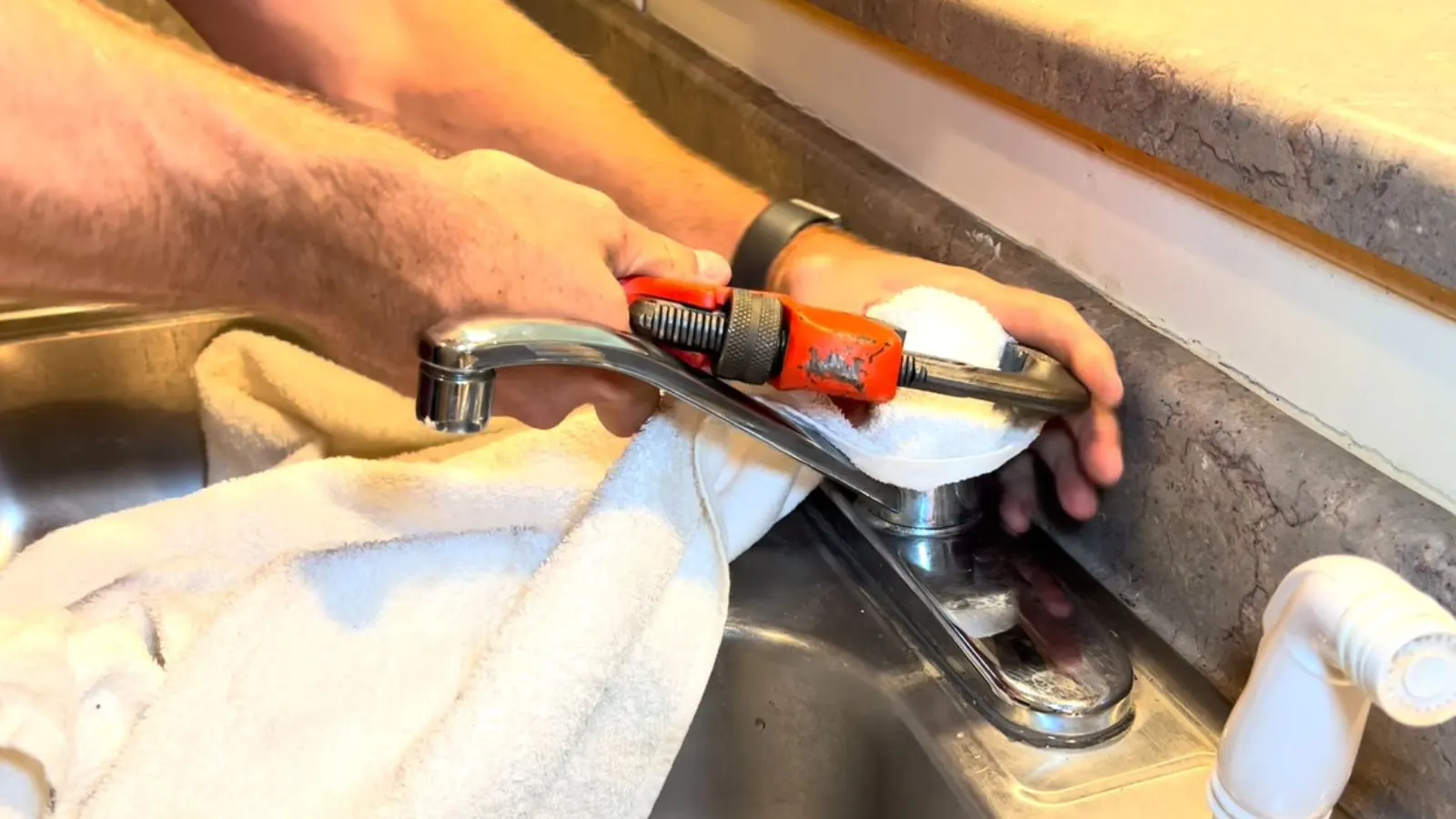
An outdoor water faucet, also called a hose bib or sillcock, is a valve on the outside wall of your house that feeds a garden hose. Outdoor water faucet repair in Dolton, IL usually means one of three jobs: replacing a washer that drips from the spout, tightening or replacing the packing that leaks behind the handle, or swapping a faucet that split over winter.
The fix depends on where the water shows up. Water at the spout is a different problem from water at the handle, and water inside the wall is a third problem that this article will not talk you into fixing yourself.
Where the water shows up tells you the repair
Check the faucet with the hose removed and the handle fully closed. Then match what you see to the table.
| What you see | Usual cause | Repair | DIY or plumber |
|---|---|---|---|
| Drip from the spout when closed | Worn rubber washer or damaged seat | Replace the washer, or the stem | DIY for most people |
| Water behind the handle when open | Packing nut loose or packing worn | Snug the nut, then repack | DIY |
| Spray from the vacuum breaker cap | Worn breaker or stuck relief | Replace the breaker head | DIY |
| Water inside the basement wall after use | Crack or loose joint behind the faucet | Open the wall, replace the faucet and pipe | Plumber |
| Handle spins and nothing changes | Stripped stem threads | Replace the faucet | DIY or plumber |
How to fix a dripping hose bib
You need an adjustable wrench, a screwdriver, a few replacement washers and a rag. Allow about 30 minutes.
Shut off the supply
Close the interior shut-off valve for the outside line if you have one. If not, turn off the main water valve, then open the faucet to drain it.
Remove the handle and packing nut
Take out the handle screw, lift the handle off, and loosen the packing nut with a wrench. Turn it counterclockwise and keep the stem straight as it comes out.
Replace the washer or packing
A flat rubber washer sits on the end of the stem, held by a small brass screw. Swap it for one of the same size, and wrap new graphite packing string around the stem under the nut.
Reassemble and test
Thread the stem back in, snug the packing nut until the handle still turns freely, then restore the water. Check the spout and the handle for drips for a few minutes.
Water leaking inside the wall?
Leave the stem alone and call us. We can find where the pipe is cracked and give a clear price before work starts.
If the whole faucet needs replacing, you will choose between two designs. The difference is where the shut-off seat sits.
Standard hose bib
- Seat sits right behind the handle, close to the outer wall
- Cheaper and simple to swap
- Holds water in the barrel if a hose stays attached
- Needs a separate interior shut-off to drain for winter
Frost-free sillcock
- Long stem puts the seat deep inside the heated space
- Costs more up front but drains itself when shut
- Must tilt slightly downward so water runs out
- Still splits if a hose is left on in a freeze
Neither design survives a hose left screwed on through a cold snap. A frost-free faucet only helps when the barrel can empty, which is why we also check the tilt when we do faucet repair outdoors.
What Dolton weather means for a hose bib
Cook County's hazard mitigation plan for Dolton ranks severe winter weather second among the village's hazards, behind severe weather in general. It also puts annual precipitation at about 36 inches. Water that sits in a faucet barrel and then freezes expands and can split the brass or the pipe behind it.
The practical step is simple. Remove and drain hoses before the first hard freeze, shut the inside valve if your faucet has one, and open the outside spout to let the line empty. The plan does not give a frost depth for Dolton, so we do not quote one here. Treat any night forecast below freezing as a night when a full barrel is at risk.
Source: Cook County hazard mitigation plan, Dolton annex, 2024.
Fall shut-down checklist for outdoor faucets
Run through this list once before the first freeze. It takes ten minutes and avoids most winter faucet damage.
- Unscrew every garden hose and splitter, including the ones on a timer
- Drain the hoses and store them indoors
- Close the interior shut-off valve to each outside faucet, if one exists
- Open the outdoor spout and leave it open so the barrel can empty
- Look for a faucet that tilts upward, which can trap water
- Cover a standard hose bib with an insulated dome only after it is drained
A faucet that froze and cracked in winter
A split faucet often shows no sign until spring. You open the spout, and water sprays out of the side of the barrel or soaks the basement ceiling. The crack is usually in the brass, or in the copper right behind it, and a new washer will not touch it.
If you turn on the outside water and see wet drywall or hear a hiss in the wall, shut the water off at the main valve right away. For that situation read our page on burst pipe repair, because water inside a wall keeps running until someone stops it.
When to stop and call a plumber
Replacing a washer is a safe weekend job. Cutting out and sweating a new copper fitting is not, because it needs a torch near framing and a tested connection. Call a plumber if the faucet is soldered into the wall and the stem will not come out, if the shut-off valve inside will not close, or if you see water stains on the ceiling below.
Also stop if you cannot find the cause. Repeated drips can come from a seat that is pitted, which a new washer cannot seal. In that case the whole faucet should be replaced. Illinois requires plumbing work to follow the Illinois Plumbing Code, and permit rules vary, so ask the Dolton building department before cutting into pipe.
What a hose bib repair usually does not fix
A new washer stops a drip, and nothing else. It will not fix low pressure, which usually comes from a partly closed valve or a kinked hose. It will not fix a cracked pipe inside a wall. It also will not fix a vacuum breaker that sprays because it is blocked or worn.
If you have a brand new faucet and still see a drip, check that the stem washer is seated flat and that the packing nut is tight but not crushed. Overtightening is a common mistake and can score the stem. A little graphite packing and a gentle quarter turn usually does it.
Serving nearby towns
We work from 1205 E Sibley Blvd in Dolton, and we cover ZIP 60419 plus the neighboring towns. Homeowners in Harvey and Calumet City often call about sillcocks that failed on the shady side of the house where frost lingers.
Landlords can call with a unit number and a note on whether the line is shared. We can often schedule a same-day appointment when available, and we explain the repair and the price before any work starts.
What to do when an outdoor faucet leaks or freezes
Outdoor faucets fail in two ways, a slow drip at the handle and a split pipe behind the wall. This short list covers what to do in both cases, and it follows the standard guidance to stop the water first.
- Shut off the interior valve that feeds the outdoor faucet if you can find it
- Disconnect the hose, because a hose left on traps water and freezes the line
- If water sprays inside the wall or basement, close the main valve and call the 24/7 line
- Do not use a torch to thaw a frozen line near walls or insulation
- Take a photo of any damage before you repair or dry anything
Questions readers ask
Water is leaking from the vacuum breaker or the hose connection, not from the valve. Replace the hose washer first. If it still drips, the vacuum breaker cap is worn and the breaker head needs replacing.
Often yes, if a small shut-off valve sits on the pipe feeding it, usually in the basement ceiling near the wall. Many older houses have none, so you shut the main valve instead. Test the valve before winter, not during a leak.
Look at the barrel. A frost-free sillcock has a long body, often 6 to 12 inches, and the stem runs deep inside. A standard bib has a short barrel. Check for a tilt as well, because the barrel must slope slightly downward to empty.
Not with a hose attached. Remove the hose, drain it, and turn the water off to that line before the cold arrives. A hose left on traps water in the barrel and splits the faucet in many cases.
Permit rules vary, so ask the Dolton building department, Housing and Permits, at 708-201-3261 before replacing a faucet that needs cutting pipe. A washer or packing swap on the existing faucet does not touch the pipe.
The barrel probably froze and split. Close the main water valve, because the leak is likely inside the wall too, then call for a repair. A cracked pipe needs replacing, not tightening.